Baby Blanket Color Combinations: Palettes That Work and How to Choose
A baby blanket palette that works is usually two or three colours: a light neutral such as cream or white, one main colour, and sometimes a darker shade of the same family. Cream, beige and taupe is the safe gift when you know nothing about the nursery. Sage or dusty blue on cream suits a baby whose sex is a surprise.
Two quick checks, skipped by most colour guides, come before you buy: will the stripes still show, and will the strongest colour bleed into the cream?
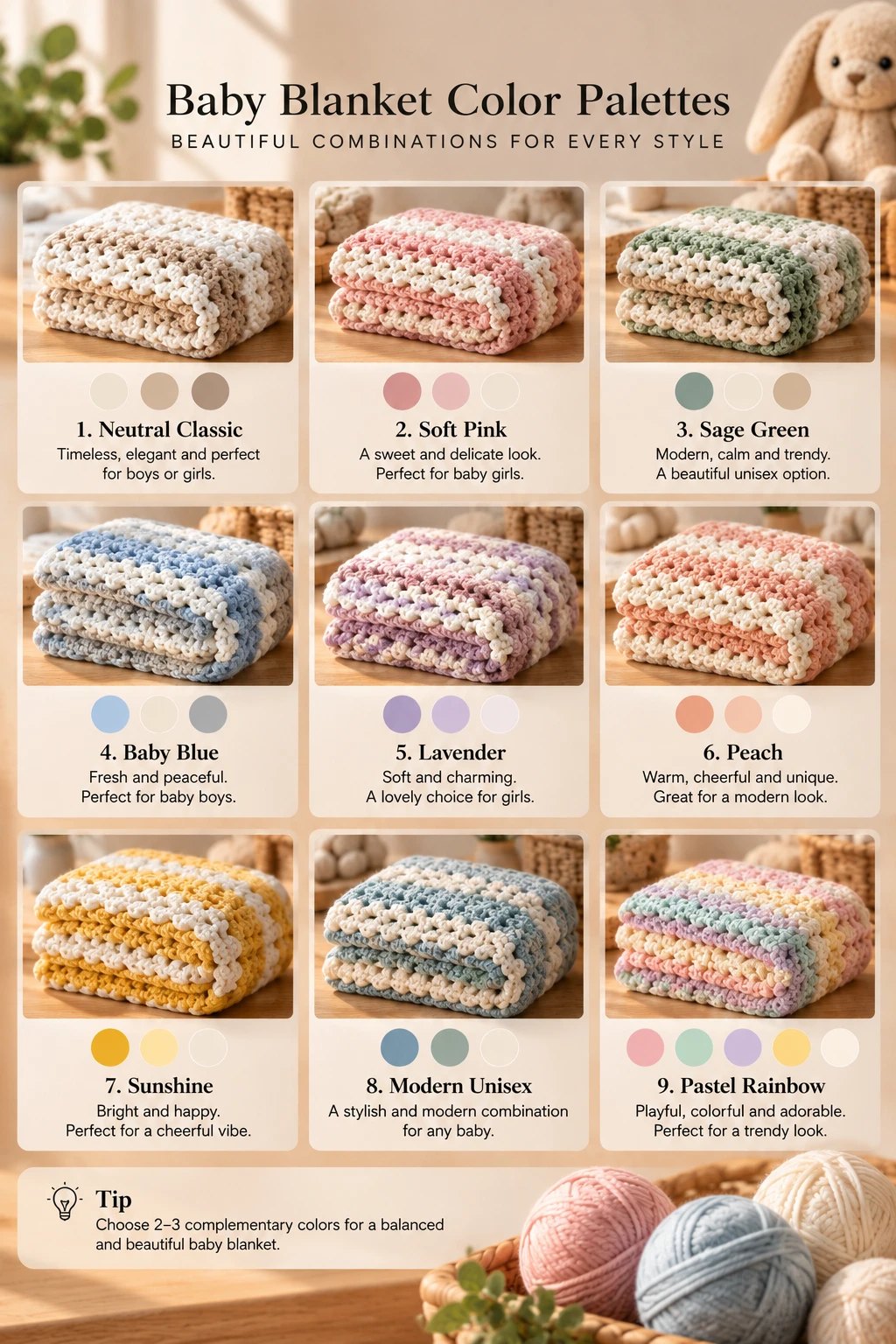
Which colour combinations work for a baby blanket?
| Palette | Colours | Usually read as | In greyscale | Before you start |
|---|---|---|---|---|
| Neutral Classic | Cream, beige, taupe | Unisex | Clear light, mid and dark | Any transfer would be faint |
| Soft Pink | Rose, blush, cream | Girl, by convention | Even steps | Soak-test the rose |
| Sage Green | Sage, cream, tan | Unisex | Even steps | Any transfer would be faint |
| Baby Blue | Blue, cream, grey | Boy, by convention | Blue and grey close | Use a darker grey |
| Lavender | Lavender, lilac, white | Girl, by convention | Even steps | White can yellow in storage |
| Peach | Coral, peach, cream | No fixed convention | Even steps, all light | Soak-test the coral |
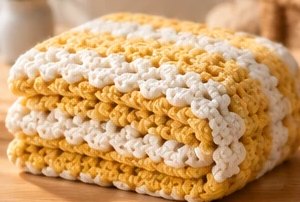
| Sunshine | Mustard, butter yellow, cream | Unisex | Butter yellow and cream match | Soak-test the mustard |
| Modern Unisex | Dusty blue, sage, cream | Unisex | Blue and sage close | Cream row between them |
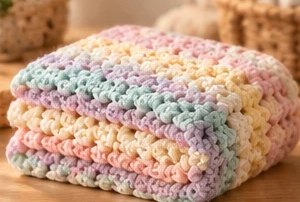
| Pastel Rainbow | Pink, mint, lavender, butter yellow, cream | No fixed convention | Pink and lavender match; all light | Five dye lots to match |
The greyscale column measures the pin’s screen swatches, not real yarn, so it demonstrates the check below rather than judging any brand.
Which palettes suit a surprise or a unisex gift?
When the sex is a surprise, or you do not know the parents’ taste, start from the neutrals. Neutral Classic steps cleanly from light to dark and sits quietly in almost any nursery.
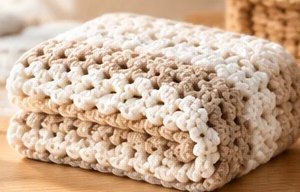
Sage Green and Modern Unisex put a muted colour on the same cream base. They are also the closest of the nine to Jade, a green in Pinterest’s 2026 colour palette, though that palette says nothing about nurseries.
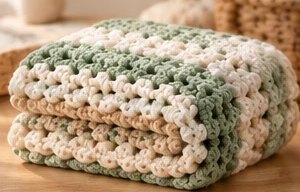
In Modern Unisex, the dusty blue and the sage are close in lightness. A cream row between them keeps both stripes visible.
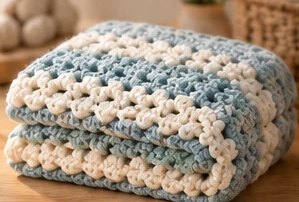
Are pink, blue and lavender still the default?
Soft Pink, Baby Blue and Lavender follow the US convention of pink for girls and blue for boys. It is still strong: in a 2022 YouGov poll of 1,000 US adults, blue topped the list for a boy’s nursery and pink for a girl’s. But it is a convention, not a rule. Smithsonian Magazine, drawing on the historian Jo Paoletti, reports that a 1918 trade publication gave the accepted rule as pink for boys and blue for girls, and that today’s version did not settle until the 1940s.
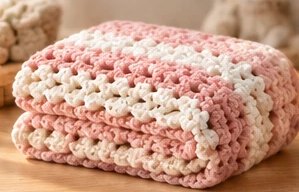
Soak-test the rose, because red-leaning colours are the usual suspects for bleeding. In Baby Blue, the blue and grey are close in lightness, so pick a darker grey if both stripes should read.
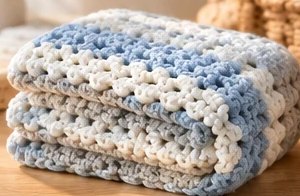
Lavender is the only palette of the nine built on pure white rather than cream, and white tends to yellow with age.
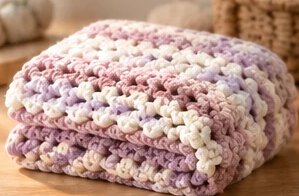
What about warmer, brighter palettes?
Peach, Sunshine and Pastel Rainbow carry no strong boy-or-girl reading. Peach and Sunshine also put a saturated colour, coral or mustard, right next to cream, so soak-test those two shades.
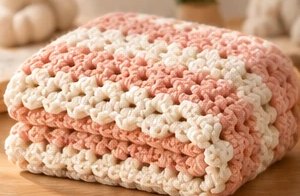
Sunshine and Pastel Rainbow also lose a stripe in greyscale; more on that next.
Will the stripes still show?
From across a room, a stripe stands out mostly through value: how light or dark the yarn is. Two knitting blogs, Elizabeth Smith Knits and Pacific Knit Co., recommend the same check: photograph the yarns together, then remove the colour with a black-and-white filter. Yarns that turn the same grey tend to read as one band from a distance.
We ran that check on the pin’s swatch circles, measuring lightness on the L* scale, where 0 is black and 100 is white. In Sunshine, the butter yellow and the cream both measure 91, so in greyscale they are identical. In Pastel Rainbow, the pink and the lavender both measure 78, and all five shades sit between 78 and 95. Screen swatches are not yarn, but pastels are all light, so that is where value runs out.
A matched pair is fine for a soft, blended look. For stripes that show, swap one for a darker shade of the same family, or work a narrow row of cream or white between them.
How many colours, and how much of each?
Two or three colours suit most baby blankets. The Blue Elephants, one of the guides that ranks for this search, advises fewer for textured stitches, where several colours can look muddled.
For proportions, borrow the 60-30-10 convention from interior design: roughly 60% main colour, 30% secondary, 10% accent. A stripe repeat of six rows main, three secondary and one accent hits those shares, if the rows are the same height.
One correction to our own pin: its tip says “complementary colours”, which strictly means opposites on the colour wheel, a bold pairing. These nine are gentler, mostly one colour family plus a neutral, so “colours that go together” is more accurate.
Will the colours survive the wash?
The risky pairing is a saturated colour, such as coral, mustard, rose or navy, right next to cream or white.
Soak-test the strongest colour
Handwoven magazine’s Madelyn van der Hoogt describes a home test. Soak a generous bundle of the strong colour in warm water with a white cloth. Coloured water means it will likely bleed. If the water stays clear, squeeze the wet yarn into the cloth, let it dry, and look for a tint. Most bleeding happens as a piece dries, she notes, so never leave a wet blanket sitting. Knit Picks checked one of its yarns another way, with a swatch of deep red beside cream, washed hot. No brand is guaranteed, so test what you buy.
If dye does move, treat it before the dryer: the University of Illinois Extension suggests a heavy-duty liquid detergent and an all-fabric (oxygen) bleach soak, and warns that a washed-and-dried dye stain is very hard to remove. For the routine wash, see how to wash a crochet baby blanket.
Buy one dye lot per colour
Lion Brand says it cannot match dye lots, which can look alike under one light and different in daylight, and advises buying everything from one lot at once. A three-colour blanket is three lots to get right, and the accent is the easiest to under-buy. Check every skein, and use our yardage guide to buy enough first time.
White, cream or a mid-tone?
A mark shows by contrast, so in principle taupe or sage hides marks better than stark white. That is reasoning, not a tested finding, so do not let it put you off cream. White has one more drawback: the Drycleaning & Laundry Institute notes that nearly all white fabrics yellow somewhat over time.
What can a newborn actually see?
Less than the palettes suggest. The American Academy of Pediatrics says newborns see best at about 8 to 12 inches and prefer high-contrast patterns, and that babies see colours better by about 4 months. The American Optometric Association puts good colour vision at about 5 months, the American Academy of Ophthalmology at 5 to 8 months. A 2022 review in Child Development Perspectives found that newborns detect colour only when it is strongly saturated, and that sensitivity to pale colour stays below adult levels well beyond infancy.
So pastels are a choice for the parents, which is fine. For awake, supervised time, such as tummy time on the floor, a palette with a darker shade (Neutral Classic, Sage Green or Modern Unisex) gives more contrast. None of these sources says blanket colour affects a baby’s development. And the AAP’s safe-sleep guidance keeps loose blankets out of the sleep space for the first 12 months: see are crochet blankets safe for babies?
What most guides get wrong
They stop at the colour. The roundups that rank for this search choose by hue and theme. None we read mentions value, and pastels are where value runs out.
They forget the washing machine. A palette is not finished until the strongest colour has passed a soak test and each colour comes from one dye lot.
They imply pastels are for the baby. Newborns favour strong contrast. The softness is for the adults, which is a fine reason to choose it.
Frequently asked questions
What colours are gender neutral for a baby blanket? No official list exists. In YouGov’s 2022 poll, white was the one colour named for both boys’ and girls’ nurseries; cream, beige, taupe, grey and sage are also commonly treated as unisex.
Is a white or cream blanket impractical? Not if the yarn is machine washable, which matters more than the colour. All nine palettes here are built on white or cream.
How many colours should a baby blanket have? Two or three for most patterns, fewer for heavily textured stitches. Every extra colour is one more dye lot to match.
Will red yarn bleed onto white? It can. Reds and other saturated colours are the usual suspects, and no brand is guaranteed, so soak-test first.