Baby Bootie Size Chart: Sole Length by Age
A newborn bootie sole is 3 to 3½ inches long. Add about half an inch per three months after that. Sole length is the only measurement that matters for booties — width sorts itself out, and there is no standard bootie sizing anywhere, so every chart including this one is a convention.
The size chart
| Age | Sole length | Sole length (cm) | US shoe size (approx) |
|---|---|---|---|
| Preemie | 2½–3 in | 6.5–7.5 cm | — |
| Newborn | 3–3½ in | 7.5–9 cm | 0–1 |
| 0–3 months | 3½ in | 9 cm | 1 |
| 3–6 months | 4 in | 10 cm | 2 |
| 6–9 months | 4¼ in | 11 cm | 3 |
| 9–12 months | 4½ in | 11.5 cm | 3–4 |
| 12–18 months | 5 in | 12.5 cm | 4–5 |
| 18–24 months | 5¼ in | 13.5 cm | 5–6 |
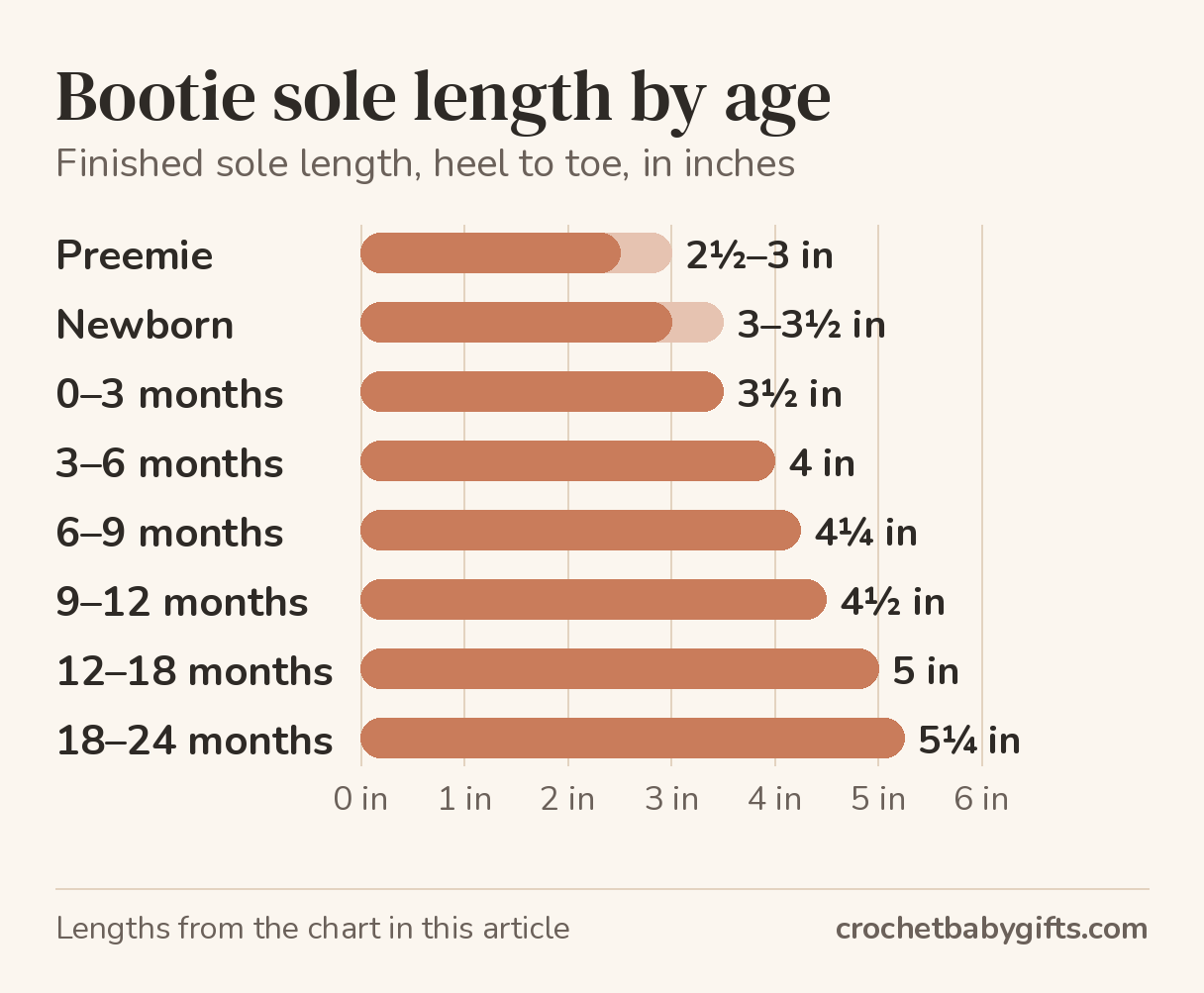
Making a gift with no measurements? Make the 3–6 month size. Newborn booties fit for a few weeks and, like newborn clothes, everyone gives them.
The two features that decide whether they stay on
This is the actual problem with handmade booties. Sizing is easy; retention is not. Babies pull booties off, and loose ones come off on their own.
1. An ankle strap, tie or ribbed cuff. A plain bootie with an open ankle will come off within the hour. Something has to close around the ankle. A ribbed cuff is the safest option for a gift because it needs no adjustment and there is nothing to come loose.
2. A snug fit through the instep, not just the right sole length. Most booties that fall off are correctly sized on the sole and too loose across the top of the foot.
If you want booties that stay on and you can only do one thing, do the ribbed cuff.
A safety note on ties
Ribbons and drawstring ties on baby footwear are an entanglement risk, and it is the reason many hospital donation programmes ban them outright.
If you are making booties as a gift and want them worn without supervision, use a ribbed cuff or a crocheted-in strap with a securely fastened button rather than a threaded ribbon. If you use a button, sew it on with the same thread you would trust on a coat and give it a firm tug — a button that comes off a bootie is a choking hazard, not just a repair.
How to measure a foot that will not hold still
Babies do not cooperate and they curl their toes, which makes a foot measure shorter than it is.
The paper method, which works:
- Put the baby’s heel against a wall or a book spine, on a sheet of paper.
- Mark the paper at the end of the longest toe. Do it while the foot is flat and relaxed — if the toes are curled, wait.
- Measure heel mark to toe mark.
- Add ¼ inch of growing and wiggle room. That is your sole length.
Do it while they are asleep if you can. Genuinely.
Booties versus socks, honestly
For a newborn, socks stay on better than most handmade booties and cost nothing. Booties are largely a keepsake and a photograph item, and there is nothing wrong with that — but if the goal is a warm foot, a well-fitting sock wins.
The case for booties is that they are the fastest keepsake to make. A pair takes an evening, uses under 50 yards, and pairs naturally with a hat as a two-piece gift.
What most bootie charts get wrong
They give a shoe size and stop. Baby shoe sizing differs between US, UK and EU systems and between brands. Sole length in inches or centimetres is unambiguous; a shoe size is a translation with error bars.
They ignore retention entirely. A chart that gets the length right and produces booties that fall off has not solved the problem.
They present these numbers as standards. There is no governing standard for bootie sizing. Foot length by age varies widely between healthy babies, and this chart is the middle of a range.
They still recommend ribbon ties as a design feature without mentioning why donation programmes ban them.
Frequently asked questions
What size booties for a newborn? A 3 to 3½ inch sole. Make 3½ if you are unsure — slightly big is wearable, slightly small is not.
How do I stop baby booties falling off? A ribbed cuff or an ankle strap, plus a snug fit across the instep. Sole length alone does not keep them on.
How much yarn does a pair of booties take? Typically 30–50 yards in DK weight. One skein makes several pairs, which makes them ideal for using up leftovers.
What yarn weight for booties? DK (weight 3) with a 3.5–4 mm hook. Weight 4 makes booties stiff and bulky on a small foot.
Should booties be tight? Snug at the ankle, roomy at the toes. Never tight across the foot — infant feet are soft and cartilaginous and should not be constrained.
Can I use a ribbon tie? For a supervised keepsake, yes. For everyday wear or a hospital donation, no — use a ribbed cuff instead.