Crochet Pouch Clutch With a Hidden Frame: Free Pattern in Three Frame Sizes
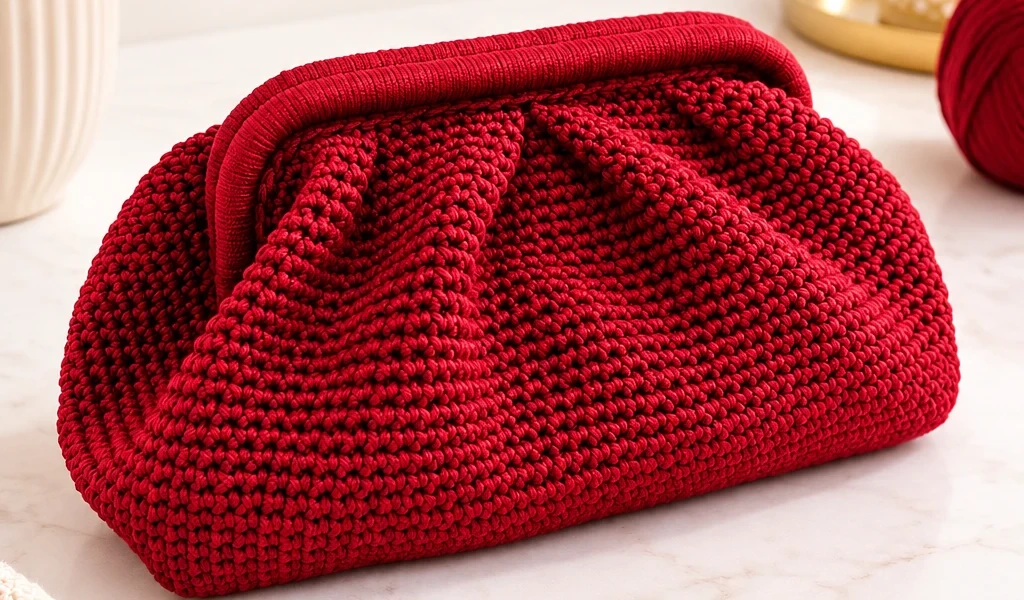
Crochet a flat rectangle for the base, work the sides straight up from it in single crochet, fold two pleats into the top of each face, then single crochet over the bars of a hidden clasp frame. On a 20 cm frame in 2 mm macrame cord the clutch comes out about 36 cm wide and 22 cm tall laid flat, gathered at the top to the frame. The 25 and 30 cm frames are in the size table.
Download the free printable PDF: the whole pattern, the size table and the diagram, ready to print. No sign-up.
This is our own design. A script checks every row, round and pleat against the frame, and the sizes are estimates worked out from a gauge, so the first thing to check is your own base against the size table.
Find what you need: pick your frame · materials · the videos · the pattern · cord.
Pick your frame
| Frame | Clutch, laid flat | Base | Foundation chain | Rounds | Cord |
|---|---|---|---|---|---|
| 20 cm | about 36 × 22 cm (14.25 × 8.75 in) | about 24.5 × 10.5 cm | 40 ch | 30 | about 330 g (300 to 400 m) |
| 25 cm | about 45 × 28 cm (17.75 × 11 in) | about 30 × 13.5 cm | 49 ch | 38 | about 520 g (470 to 620 m) |
| 30 cm | about 54 × 33.5 cm (21.25 × 13.25 in) | about 35.5 × 16.5 cm | 58 ch | 45 | about 730 g (660 to 880 m) |
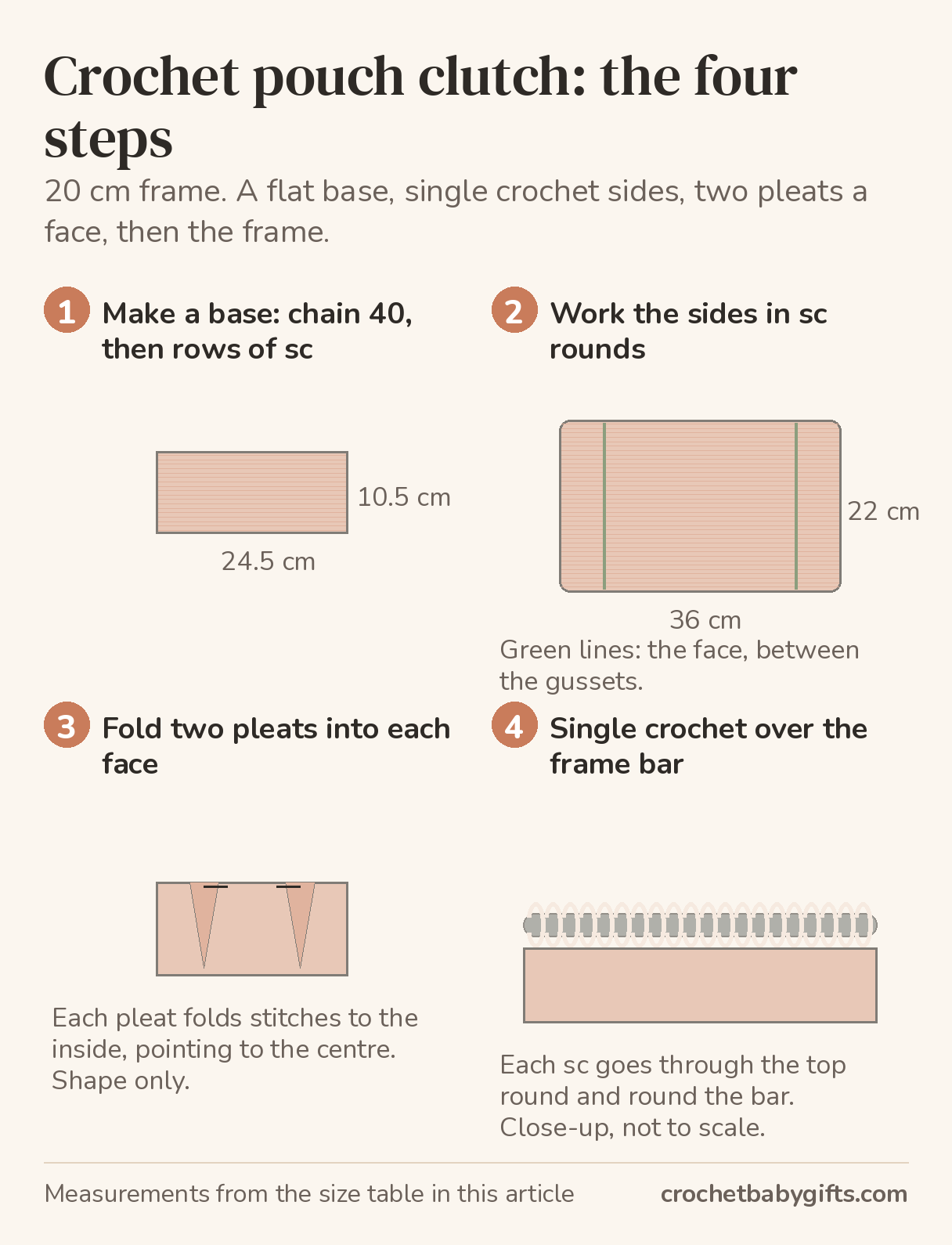
Hidden clasp frames are sold by their length closed: 20 cm is the most common, then 22 to 25 cm, then 30 cm. The part you crochet over is shorter, so the pattern allows a mouth 3 cm shorter than the length on the packet. Measure yours before you start: if its bar is more than 1 cm longer or shorter than the frame named in the table, use the nearest size.
What you need
Every tool our patterns use is on the Crochet essentials page.
- 2 mm macrame cord, cotton or polyester, the amount in the size table. Cords of this thickness run 90 to 120 m per 100 g, so check your label.
- A hidden clasp frame, also sold as a click clack frame, a magic lock or an internal tubular frame, in the length you picked. The kind made of round tubes is the one to crochet over.
- A 4 mm crochet hook, four locking stitch markers, a tapestry needle with a large eye and scissors.
Gauge and abbreviations
Gauge: about 16 single crochet and 18 rows to 10 cm (4 in) in 2 mm macrame cord on a 4 mm hook. We have not measured this on the clutch yet. Nobody publishes a gauge for this exact cord and hook, so it is a planning figure from the nearest published ones, and every size on this page is worked out from it. Make a small swatch first.
The quick check is the base: after the last base row it should measure the size in the table. If it is more than 1.5 cm off, change your hook by half a size and start again.
US crochet terms throughout. The UK name is in brackets.
- ch: chain. sl st: slip stitch. st(s): stitch(es).
- sc: single crochet (UK: double crochet).
- Row end: the side edge of a row. Work one sc into the edge of each row.
- Face and gusset: the two wide sides of the clutch are the faces; the two narrow strips between them, above the short ends of the base, are the gussets.
- 40 (49, 58): the first number is for the 20 cm frame, the ones in brackets for the 25 and 30 cm frames.
The videos
Both videos make a pleated pouch clutch on a hidden frame, so their rounds and counts are not the ones on this page. They are worth watching for the moves the bags share.
Kristina Virka works in paper yarn, starts from a rectangle base worked in rounds with increases, and sews her frame in by wrapping the yarn round the bar.
- Choosing the bag size from the frame from 2:01.
- The bag body from 14:34.
- Lining a crochet bag from 15:14, if you want to add one.
- Pleats from 20:39, for step 3.
- Adding the frame from 26:21, for step 4.
Video: Kristina Virka, “Crochet Bag With Hidden Clasp Frame & Lining”, 2022, 30 minutes. A different design; the pattern on this page is our own.
Mozy Mory makes the whole clutch in 2 mm macrame cord on a 4 mm hook, the materials this page uses, in a one-hour make-along spoken in Arabic.
Video: Mozy Mory crochet, “Crochet bag / clutch crochet with a magic lock”, 2025, 60 minutes. A different design; the pattern on this page is our own.
The pattern
1. Base
Worked in rows.
- Foundation: ch 40 (49, 58).
- Row 1: sc in 2nd ch from hook and in each ch across. [39 (48, 57) sts]
- Rows 2–19 (2–24, 2–29): ch 1, turn, sc in each st. [39 (48, 57) sts]
Do not fasten off. The base should measure about 24.5 × 10.5 cm (30 × 13.5 cm, 35.5 × 16.5 cm).
2. Body
Work in a continuous spiral without joining, with a marker in the first stitch of each round, moved up as you go. In round 1, also put a marker in the first stitch of each of the four sides, so you can find the faces and gussets later.
- Rnd 1: sc 39 (48, 57) across the last row, sc 19 (24, 29) down the row ends, sc 39 (48, 57) along the foundation chain, sc 19 (24, 29) up the row ends. [116 (144, 172) sts]
- Rnds 2–30 (2–38, 2–45): sc in each st. [116 (144, 172) sts]
Sl st in the next 2 sts to smooth the step of the spiral, and fasten off. Move the four corner markers up to the last round, straight above where they were.
3. Pleats
Each face has 39 (48, 57) sts across each face, between its two corner markers. On each face, make two pleats, a quarter of the way in from each corner, both folding towards the centre: fold 6 (6, 7) sts to the inside, so that the stitch before them meets the stitch after them, and pin the fold through the top round. The face now measures the same as the frame’s mouth.
4. Frame
Open the frame. Hold one bar along the inside of the top edge of a face, with its hinges at the corner markers. Join the cord at the first stitch of the face and sc 27 (36, 43) over the bar: put the hook through the top round, through all the layers at a pleat, bring it out on the far side of the bar, and work the sc so it wraps the bar. Work the second face over the other bar the same way.
Leave the 19 (24, 29) sts between the bars free at each side. These are the gussets, and they fold in when the frame shuts. Sl st along their top for a neat edge, and weave in every end.
Cord and time
A 20 cm clutch takes about 330 g of cord. That is scaled by area from the one published 2 mm cord clutch with a weight, Mozy Mory’s 500 g for a bigger bag, so it is an estimate.
It is about 4,300 stitches, all single crochet: a project for several evenings rather than one.
If something goes wrong
The bag is much wider than the frame can gather. Your stitches are looser than the gauge. Either go down half a hook size, or fold the extra into the pleats: deeper pleats are fine as long as the two on each face match.
The frame will not shut. The gussets are pulling. Check that the sc over the bar stop at the corner markers and that no gusset stitch is caught on a bar.
The base curls. Work round 1 a little loosely, and do not add stitches at the corners: the base turns up into the sides on its own.
Frequently asked questions
Is this a good first project? It is one stitch all the way, so it suits a confident beginner. The fiddly part is working over the frame, and both videos above show it.
Can I make it in raffia? Yes. Published raffia gauges on 3.5 mm are close to 18 sc per 10 cm, a little tighter than the cord, so the same counts make a slightly smaller clutch. Check the base against the table and choose the frame that fits.
Can I add a lining? Yes. Kristina Virka’s video shows a sewn fabric lining from 15:14. Fit it before the frame goes on.