Crochet Baby Sundress With Flower Straps: Free Pattern, 6 to 24 Months
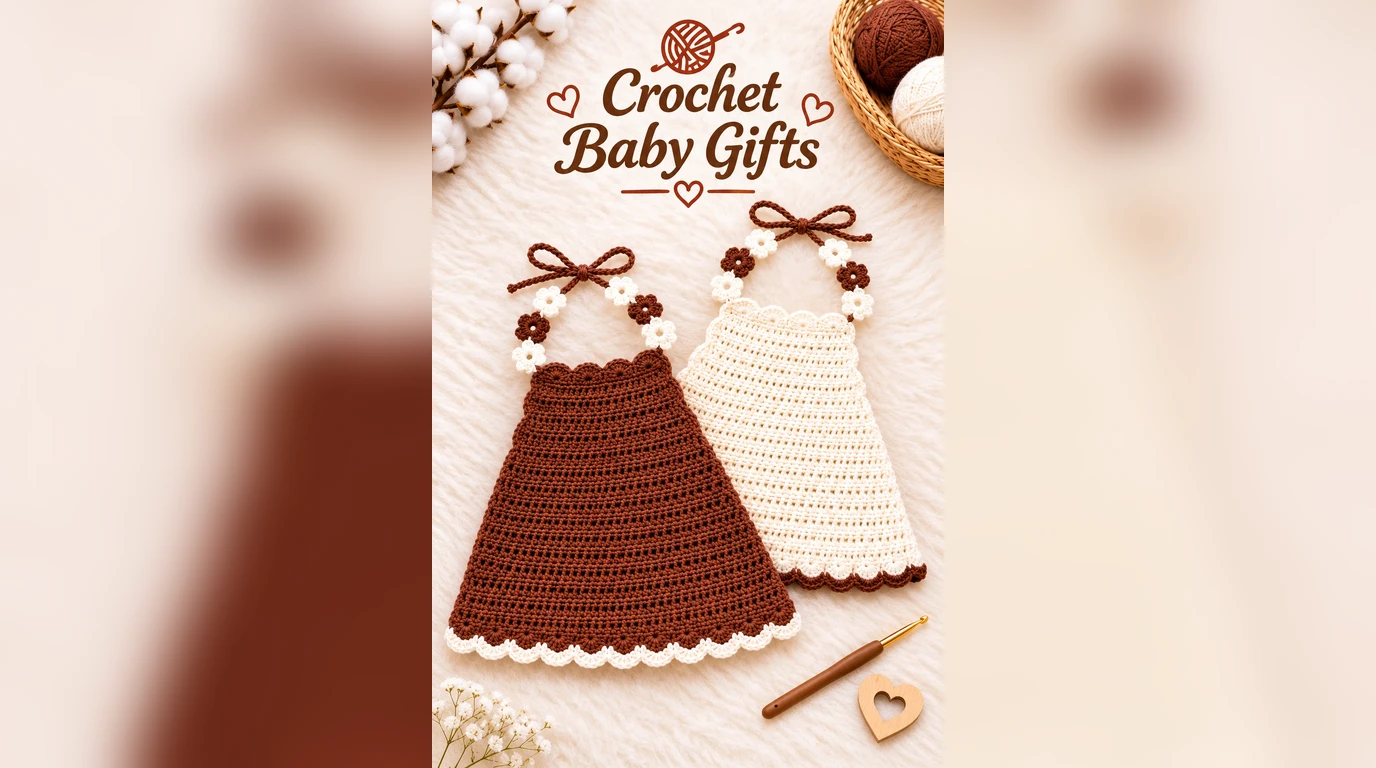
Crochet the top edge first, leave a short slit at the back, then work an A-line body in rounds of double crochet with small eyelets, a scalloped hem in a second colour and a scalloped top edge. Two straps with three small crocheted flowers each go over the shoulders, cross at the back and are sewn on. In DK yarn on a 4 mm hook the 12 month dress is about 49 cm round the chest and 24.5 cm long.
Download the free printable PDF: the whole pattern, the size table and the diagram, ready to print. No sign-up.
This is our own design. A script re-works every row and round against the one before it, and checks the chest against published baby measurements, the top opening against the size of a baby’s head, the straps against the shoulder and back, and the skirt against its flare rule. The sizes are worked out from a planning gauge, so they are estimates: measure Row 1 before you go on.
In the picture and the video the straps tie behind the neck. Ours are sewn to the back, because ties at a baby’s neck are a strangling risk.
Find what you need: pick your size · materials · the video · the pattern · made for a baby.
Pick your size
| Size | Baby’s chest | Dress chest | Opens to | Length | Hem | Strap | Yarn, about |
|---|---|---|---|---|---|---|---|
| 6 months | 17 in (43 cm) | about 46.5 cm | 54.5 cm | about 23.5 cm | about 64.5 cm | 26 cm | 195 m A, 40 m B |
| 12 months | 18 in (45.5 cm) | about 49 cm | 57 cm | about 24.5 cm | about 66.5 cm | 27 cm | 215 m A, 45 m B |
| 24 months | 20 in (51 cm) | about 53.5 cm | 61.5 cm | about 26.5 cm | about 71 cm | 29.5 cm | 250 m A, 45 m B |
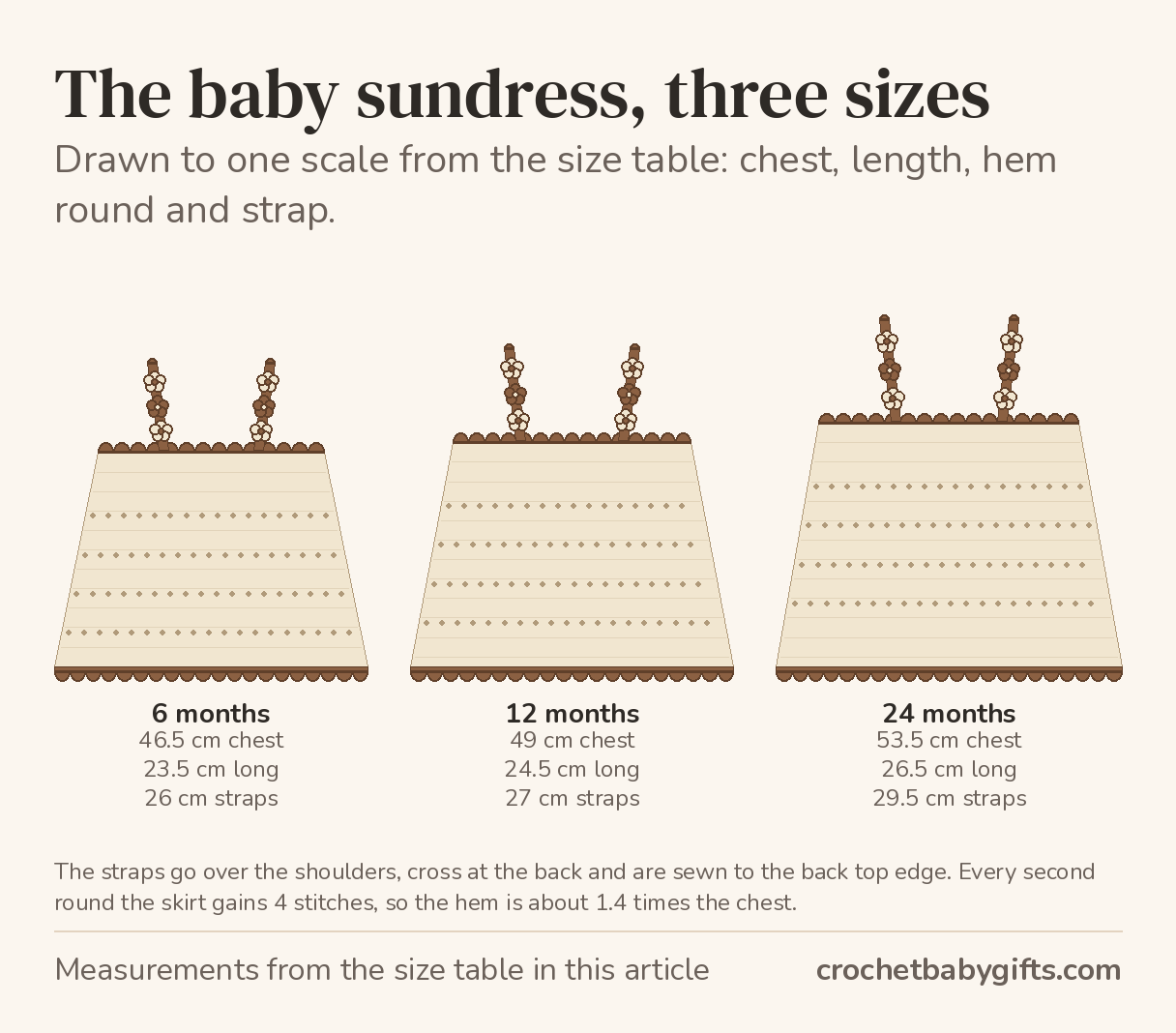
The baby’s chest is the body measurement from our baby clothing measurements page. That page adds 1 inch of ease for a vest or pinafore, because it is worn over other clothes, so the dress is 2.5 to 3.5 cm bigger round the chest than the baby, measured round the top, just under the arms. The length runs from the top edge to the tips of the hem scallops. It is the Craft Yarn Council’s back waist length less its armhole depth, plus 15 cm: 23.5 (24.5, 26) cm, the council’s tunic length for a child measured from under the arm.
The dress goes on over the head. A toddler cannot step into it: the body below the back slit is 46.5 (49, 53.5) cm round, smaller than the Craft Yarn Council’s hips at that age, 50.5 (50.5, 56) cm. So the top is worked flat for four rows, which leaves a short slit at the centre back, and then the two back edges are lapped over each other and joined. With the slit spread, the top opens to about 54.5 (57, 61.5) cm, and the heads it has to clear are 45.8 (48.6, 51.0) cm: the World Health Organization’s head size at 6, 12 and 24 months that only about 2 babies in 100 are bigger than, taking the boys’ figures because they are the larger. That leaves at least 2 cm to spare without counting on any stretch or on the lap.
The straps are sewn at both ends. Each strap is about 26 (27, 29.5) cm long, enough for 25.5 (26.5, 28.5) cm: up the front to the shoulder, across the back to the other side, and 1.5 cm sewn under the top edge at each end. That length comes from the Craft Yarn Council’s armhole depth, 9 (9.5, 10.5) cm, and half the cross back, 9.75 (10.5, 11) cm, for the slant where the straps cross.
What you need
Every tool our patterns use is on the Crochet essentials page.
- DK (#3) cotton or cotton blend baby yarn in two colours: A, cream, for the body, and B, brown, for the top edge, the hem and the straps. The amounts are in the size table. Smooth cotton shows the scallops and eyelets best.
- A 4 mm crochet hook. The hook size chart gives the US letter near it.
- Four stitch markers for the panels, a blunt tapestry needle, sewing pins and scissors.
The flowers are crochet and are sewn down flat. This dress has no fastener of any kind, and nothing hangs from it.
Gauge and abbreviations
Gauge: about 18 double crochet and 10 rows to 10 cm (4 in) on a 4 mm hook. We have not measured this on the dress yet. It is a planning figure, and every size on this page is worked out from it. We take a scallop round as one double crochet tall and a sc round as half that.
The quick check: Row 1 should measure about 49.5 (51.5, 56) cm along the top. If it is much longer or shorter, change your hook by half a size.
US crochet terms throughout. The UK name is in brackets.
- ch: chain. sl st: slip stitch. st(s): stitch(es). sk: skip.
- sc: single crochet (UK: double crochet). dc: double crochet (UK: treble).
- inc: increase, 2 dc in the same stitch.
- eyelet: ch 1 and skip the next stitch. The ch-1 space counts as a stitch in the next round.
- scallop: 5 dc in one stitch, between a skipped stitch on each side.
- 6 (12, 24): the first number is for 6 months, the ones in brackets for 12 and 24 months. A single number is for every size.
The video
Frisian Knitting’s video shows how she makes a girls’ halter dress. It is in English and about 31 minutes long. Her dress is for 2 to 3 years in Aran yarn and her counts are in her own pattern, so use the video to see how the stitches go together and follow the counts on this page for the sizes.
Video: Frisian Knitting tutorials, “How to crochet a girls halter dress”, 2026, 31 minutes. Her dress is a halter for 2 to 3 years; ours has sewn straps and baby sizes, and the counts on this page are our own.
The pattern
The dress is worked from the top edge down. The first four rows are flat, which leaves the slit at the back. Rows: ch 2, which does not count as a stitch, then turn. After Row 4 the two back edges are lapped and the dress is joined into rounds. Rounds: join with a sl st in the first stitch and do not turn. Start a dc round with ch 2 and a sc round with ch 1, neither of which counts as a stitch.
1. Top and back slit
Chain loosely, or make the chain on a hook a size bigger: the top edge has to go over the baby’s head.
- Foundation: with A, ch 91 (95, 103) loosely.
- Row 1: dc in 3rd ch from hook and in each ch across. [89 (93, 101) sts]
- Rows 2–4: dc in each st. [89 (93, 101) sts]
Do not fasten off after Row 4. Ch 2 and turn, so the right side faces you. Lay the edge you are at over the other back edge, so that 5 stitches of each sit on top of each other.
- Rnd 5: dc 5 through both back edges, dc 79 (83, 91). [84 (88, 96) sts]
Work the first 5 dc through both layers: that lap closes the slit. Put a marker in every 21st (22nd, 24th) stitch, so the round is in 4 equal panels; the last marker is in the last stitch of the round. Move the markers up as you go.
2. Skirt
- Rnd 6: [dc in each st to the marker, inc] 4 times. [88 (92, 100) sts]
- Rnd 7: [eyelet, dc 3] around. [88 (92, 100) sts]
- Rnd 8: [dc in each st to the marker, inc] 4 times. [92 (96, 104) sts]
- Rnd 9: dc in each st. [92 (96, 104) sts]
- Rnds 10–21: repeat Rnds 6–9 3 times. [116 (120, 128) sts]
- Rnd 22 (22–23, 22–25): dc in each st. [116 (120, 128) sts]
In an increase round, work a dc in each stitch up to the marked one, then 2 dc in the marked stitch, and move the marker into the second of them. Every second round each panel gains one stitch, and that is what makes the skirt flare. The skirt has 8 increase rounds in every size, so the hem is at least 1.3 times the chest. Every fourth round is a round of small eyelets.
3. Hem
- Rnd 23 (24, 26): with B, sc in each st. [116 (120, 128) sts]
- Rnd 24 (25, 27): [sk 1, 5 dc in next st, sk 1, sl st in next st] around. [29 (30, 32) scallops]
Join with a sl st in the first sl st and fasten off. The sc round and the scallops make the contrast hem.
4. Top edge and slit
- Top edge: with B and the right side facing, join with a sl st in the first ch at one back corner, [sk 1, 5 dc in next ch, sk 1, sl st in next ch] across. [22 (23, 25) scallops]
- Slit edging: with A, join at the top of one back edge, ch 1, 2 sc in the end of each row down to the lap, then 2 sc in the end of each row up the other back edge; fasten off. [16 sts]
Work the top scallops into the other side of the foundation chain, so they stand up along the top of the dress.
5. Straps and flowers
- Straps (make 2): with B, ch 48 (50, 54), sc in 2nd ch from hook and in each ch across. [47 (49, 53) sts]
Make 6 flowers: 4 in A and 2 in B.
- Flower centre: in an adjustable ring, ch 1, 5 sc, join with a sl st. [5 sts]
- Petals: (ch 2, 2 dc, ch 2, sl st) in each st. [5 petals]
Pull the ring closed tightly and weave its tail back and forth through the centre before you trim it.
6. Making up
Pin the front end of each strap inside the top edge, under the scallops, each one about 5 (5, 5.5) cm from the centre front. Take the straps over the shoulders, cross them at the back, and pin each end inside the top edge on the other side of the slit, the same distance from the centre back. Try the dress on the baby, or against a top that fits, before you sew: the straps should lie flat without pulling the top edge up.
Sew each strap end down firmly over the last 1.5 cm, with small stitches all round it, through the dress and the strap. Then sew 3 flowers flat on each strap, on the front, a cream one, a brown one and a cream one. Sew each flower down all round: through the centre ring and with a stitch at the base and the tip of every petal, so no petal can be lifted. Weave in every end back and forth through several stitches, then trim it, and turn the dress inside out to check that no strand lies loose.
Made for a baby
- Nothing tied at the neck. In the picture and the video the straps tie behind the neck. Ours are sewn to the back, because ties at a baby’s neck are a strangling risk. There is no bow, cord or loose end on this dress.
- No buttons, beads or snaps. That is why the back laps over instead of buttoning, and why the flower centres are crochet, not a bead or a button.
- Sew the flowers and straps down well, and check them. A small flower that comes off can go into a baby’s mouth. Before each wear, give each flower and each strap end a firm tug, and sew back anything that has started to lift.
- Check the eyelets and the inside. Loose threads inside baby clothes can wrap tightly round a finger or toe, a hair tourniquet. Weave every end in well, and before each wear turn the dress inside out and check for long strands or a broken stitch near the eyelets.
- Not for sleep. Take the dress off for naps and at night.
The sources for each point are on our handmade baby gift safety checklist.
Yarn and time
The 12 month dress takes about 215 m of A and 45 m of B. The amounts come from counting every stitch and allowing a published length of yarn per stitch for DK, plus the starting chains, the flowers and tails. They are upper estimates, so check the metres on your ball band before you buy.
It is about 2,900 stitches. The skirt takes the longest, and the flowers are quick: each one is a few minutes once you know the petals.
Frequently asked questions
Why does it go on over the head? The top has to fit the chest, and a baby’s hips are bigger than the chest, so the top cannot go up over them. Over the head, the short slit at the back opens the top wide enough for the head and the lap closes it again.
Can I tie the straps instead of sewing them? Not for a baby or toddler. Ties at the neck are a strangling risk. Sew both ends of each strap to the dress.
Can I make it longer? Yes. Work more plain dc rounds before the hem. Each one adds about 1 cm. The stitch count does not change, so the hem still has the same number of scallops.
Can I add sleeves? Not to this pattern as written. Our crochet baby dress with a round yoke has cap sleeves.