Crochet Baby Socks: Free Easy Pattern in Three Sizes, 0 to 12 Months
Crochet a small oval for the toe, work the foot straight in single crochet, leave a row of chains where the heel will go, then work the leg and a ribbed cuff. The heel goes in last, into that gap. In DK yarn on a 3.5 mm hook the 0–3 month sock is about 11 cm round and 9 cm from toe to heel.
Download the free printable PDF: the whole pattern, the size table and the diagram, ready to print. No sign-up.
This is our own design. A script checks every round against the one before it, the foot against our bootie size chart and the cuff against measured baby ankles. The sizes are worked out from a gauge, so the first thing to check is your own sock against the size table.
Find what you need: pick your size · materials · the video · the pattern · fit check · made for a baby.
Pick your size
| Size | Foot and ankle | Sock round | Toe to heel | Leg, heel to top | Cuff | Yarn for the pair |
|---|---|---|---|---|---|---|
| 0–3 months | 9 cm sole, ankle 10.2 to 12.9 cm | about 11 cm | about 9 cm | about 5.5 cm | 22 sts, 6 rounds | about 60 m |
| 3–6 months | 10 cm sole, ankle 11.6 to 13 cm | about 13 cm | about 10 cm | about 5.5 cm | 26 sts, 6 rounds | about 80 m |
| 6–12 months | 11.5 cm sole, ankle 12.9 to 14.5 cm | about 14 cm | about 11.5 cm | about 6 cm | 28 sts, 6 rounds | about 95 m |
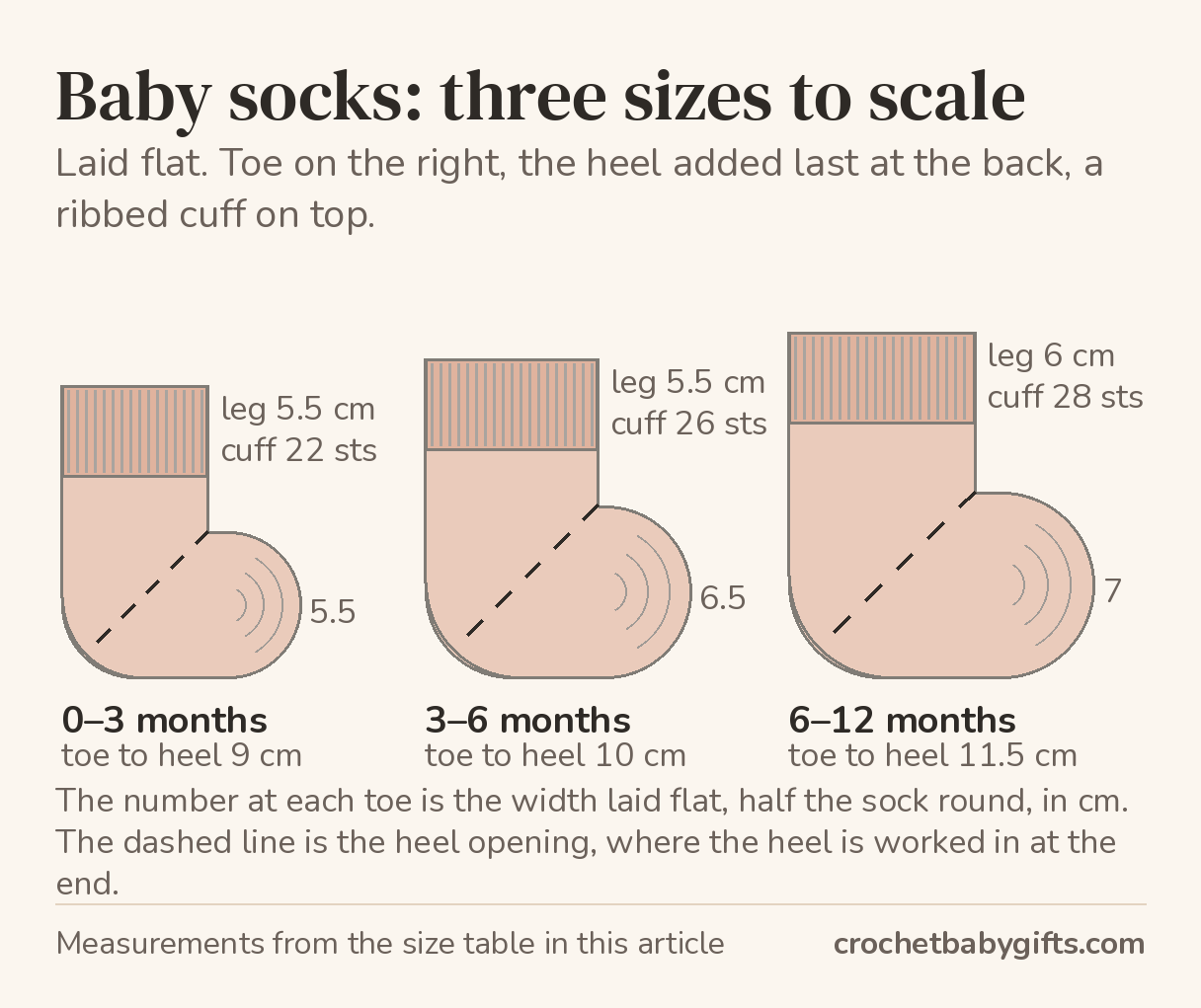
Which size, quickly: for a gift with no measurements, make 3–6 months. A sock that is a little long is worn for longer; one that is short is not worn at all.
The sole lengths are the ones on our bootie size chart, which already allow a little room past the toes. The ankle range runs from the average baby ankle in a published US survey of infants to the size only one baby in twenty is bigger than. The socks allow 0.8 to 1.4 cm more round than the average ankle.
What you need
- DK (#3) baby yarn, soft and machine washable, the amount in the size table. Leftovers from booties or mittens are enough.
- A 3.5 mm crochet hook. The hook size chart gives the US letter near it.
- Two stitch markers, a blunt tapestry needle and scissors.
Gauge and abbreviations
Gauge: about 20 single crochet and 22 rounds to 10 cm (4 in) on a 3.5 mm hook. We have not measured this on the socks yet. It is a planning figure from published DK gauges, the same one our baby mittens use, and every size on this page is worked out from it.
The quick check is round 4: laid flat, the toe should be about 5.5 cm across for 0–3 months, 6.5 cm for 3–6 months and 7 cm for 6–12 months. If it is much bigger or smaller, change your hook by half a size.
US crochet terms throughout. The UK name is in brackets.
- ch: chain. sl st: slip stitch. st(s): stitch(es).
- sc: single crochet (UK: double crochet). hdc: half double crochet (UK: half treble).
- inc: increase, 2 sc in the same stitch. dec: decrease, sc 2 stitches together.
- fphdc and bphdc: front post and back post half double crochet, the cuff’s ribbing. Our mittens page has a short video of both.
- 22 (26, 28): the first number is for 0–3 months, the ones in brackets for 3–6 and 6–12 months.
The video
Mari Rolón’s video makes a different sock from ours. Hers is worked flat and sideways, in rows of slip stitch into one half of each stitch, which gives that fine ribbed look. She shapes the heel with decreases at a marker and then increases back out, folds the piece in half and joins it with slip stitch. Her finished pair has a folded cuff and a small crocheted bow.
- Measuring the first rows against a tape from 5:00, which is how she sets the foot length.
- The first heel decrease at the marker from 7:29.
- The heel increases from 42:49.
- Folding the piece in half and joining it with slip stitch from 60:39.
Video: Todo en crochet, “Calcetines a crochet para bebé” (in Spanish, with auto-translated captions), 2023, 64 minutes. Hers is worked flat and sideways in slip stitch and seamed, ours in the round from the toe up; the counts on this page are our own.
How her video and this page fit together. They are two ways to the same gift. If you would like her sideways sock, follow her video from start to finish: it is long because she counts aloud, and YouTube’s captions can translate it. If you would rather have every round written down in three sizes, use the pattern below. Her video is still worth a look at 5:00, because measuring your work against a real foot measurement is the best fit check there is.
The pattern
Make two. Work the toe, foot and leg in a continuous spiral, with a marker in the first stitch of each round, moved up as you go.
1. Toe
- Foundation: ch 5 (7, 8).
- Rnd 1: sc in 2nd ch from hook, sc 2 (4, 5), 3 sc in last ch; working along the other side of the chain, sc 2 (4, 5), 2 sc in last ch. [10 (14, 16) sts]
- Rnd 2: [inc, sc 3 (5, 6), inc] 2 times. [14 (18, 20) sts]
- Rnd 3: [inc, sc 5 (7, 8), inc] 2 times. [18 (22, 24) sts]
- Rnd 4: [inc, sc 7 (9, 10), inc] 2 times. [22 (26, 28) sts]
The increases sit in pairs at the two ends of the oval, which become the sides of the foot, so the toe comes out flat and rounded like a bought sock.
2. Foot
- Rnds 5–15 (5–17, 5–21): sc in each st. [22 (26, 28) sts]
3. Heel opening and leg
- Rnd 16 (18, 22): ch 11 (13, 14), skip the next 11 (13, 14) sts, sc in each of the last 11 (13, 14) sts. [22 (26, 28) sts]
- Rnd 17 (19, 23): sc in each st and ch around. [22 (26, 28) sts]
- Rnds 18–19 (20–22, 24–27): sc in each st. [22 (26, 28) sts]
The round starts at one side of the foot, so the chains of the heel opening run across the sole and the stitches you work run over the top of the foot. The skipped stitches stay open: the heel is worked into them at the end.
4. Cuff
- Rnds 20–25 (23–28, 28–33): [fphdc around next st, bphdc around next st] around. [22 (26, 28) sts]
Join the ribbing rounds: sl st in the first stitch, ch 2, which does not count as a stitch, then start the round. From the second ribbing round on, the fphdc goes round each stitch that sits forward and the bphdc round each stitch that sits back. Fasten off.
5. Heel
Join the yarn with a sl st in one corner of the heel opening and work in a spiral again.
- Rnd 1: sc 1 in the corner, sc 11 (13, 14) along the skipped sts, sc 1 in the next corner, sc 11 (13, 14) along the chain. [24 (28, 30) sts]
- Rnd 2: [dec, sc 8 (10, 11), dec] 2 times. [20 (24, 26) sts]
- Rnd 3: [dec, sc 6 (8, 9), dec] 2 times. [16 (20, 22) sts]
- Rnd 4: [dec, sc 4 (6, 7), dec] 2 times. [12 (16, 18) sts]
- Rnd 5: [dec, sc 2 (4, 5), dec] 2 times. [8 (12, 14) sts]
The stitch in each corner closes the little gaps at the ends of the opening. The decreases fall in pairs at the two corners, the same shape as the toe in reverse. Flatten the heel so the corners meet, then join the two halves of the last round with sl st through both layers, on the outside of the sock so the ridge sits away from the skin. Fasten off.
6. Finishing
Weave every tail into the inside of the stitches, back and forth through several stitches, then trim it close. Turn each sock inside out and check that there are no loose loops or strands inside, then turn it back.
Fit check
- Before the cuff: slip the sock over the baby’s foot, or check it against the size table. The heel opening should sit just at the back of the heel.
- The cuff: it should stretch over the heel easily and leave no mark round the leg when you take the sock off. If it marks, work the cuff again on a hook half a size bigger.
- Too long? Unravel the cuff and leg back to the foot and leave out two foot rounds. Each round is about half a centimetre.
- Keeps falling off? The cuff is too loose: work it on a hook half a size smaller, and check the heel is not sitting up the back of the leg, which happens when the foot is too long.
Made for a baby
- A cuff that does not mark. A ribbed cuff holds by stretch, with no elastic, and it should never leave a groove.
- No pompoms, beads or ties. These socks have nothing sewn on.
- Check inside for loose threads. A loose thread or hair can wind round a baby’s toe and cut off the blood flow, which doctors call a hair tourniquet. Turn the socks inside out before each wear.
- Weave the ends well, as in the finishing step, so that no tail can work loose inside the sock.
The sources for each point are on our handmade baby gift safety checklist.
Gift ideas
- A feet set: a pair of these socks with our ribbed baby booties in the same yarn. The cuffs match.
- A first winter set: socks and thumbless baby mittens, both sized 0 to 12 months.
- For Christmas: socks in red or white beside a pair of Christmas baby booties.
- For a beginner’s first gift: the easy crochet baby booties are flatter and quicker; these socks are the next step.
Yarn and time
A 0–3 month pair takes about 60 m. The amounts come from counting every stitch and allowing a published length of yarn per stitch for DK, so they are upper estimates.
It is about 600 stitches a sock.
Frequently asked questions
Why is the heel added last? It is called an afterthought heel. The sock is a simple tube until then, so you can check the foot length before you commit to the heel, and the heel is worked just like the toe.
Will they stay on? The ribbed cuff hugs the leg above the ankle, and the heel cups the back of the foot. A sock that is too long slips off first, so check the length against the table.
Can I use a thinner yarn, like hers? Yes, but the counts are for DK. Thinner yarn on a smaller hook makes a smaller sock, so measure your round 4 toe against the gauge check above.
Is this a good first project? It is a good second one. The toe and foot are plain single crochet; the heel opening and the cuff are the new parts, and each is written out round by round.