Crochet Pique Stitch Baby Blanket: An Easy One-Row Repeat in Three Sizes, Free Pattern
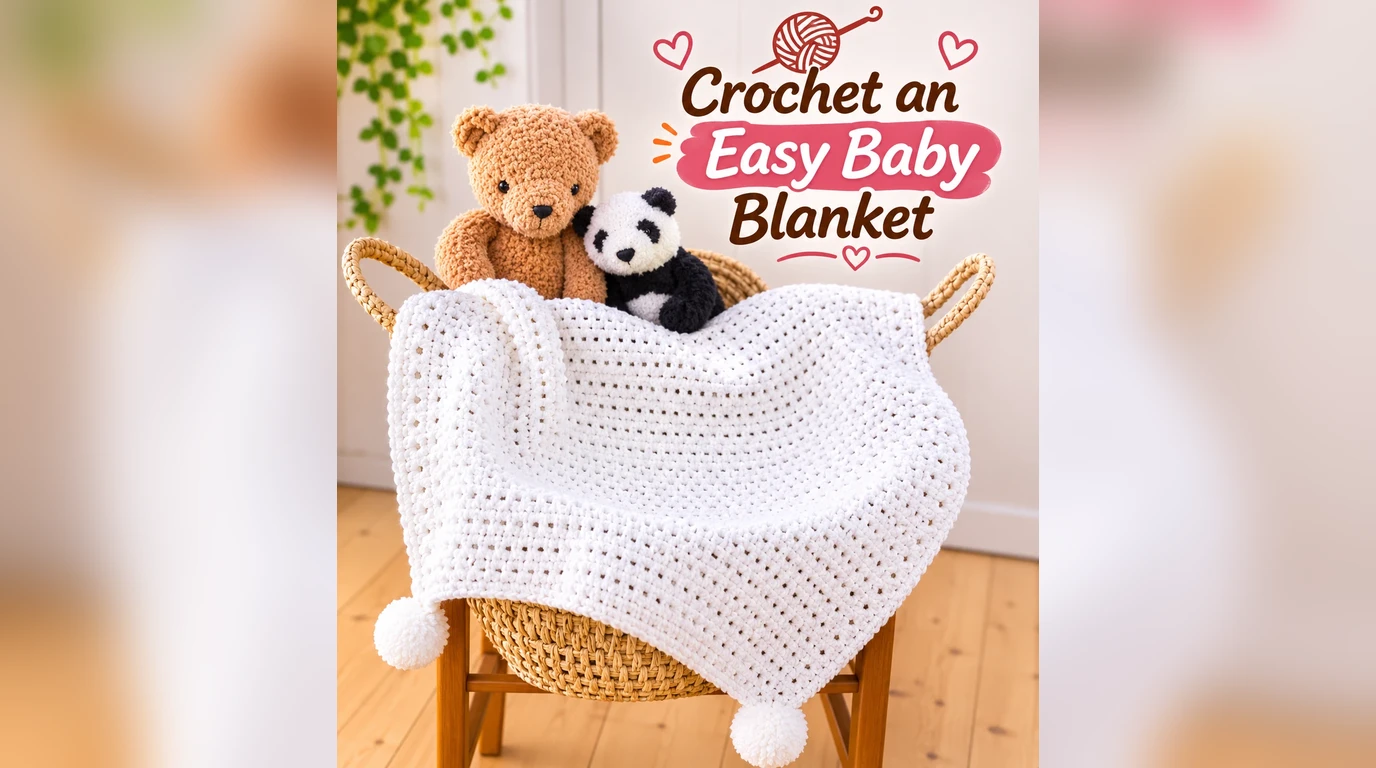
Work one row of pique clusters, the same row over and over, then go round the blanket three times in single crochet. That is the whole blanket. In worsted yarn on a 5 mm hook the receiving size is chain 70, 68 clusters in every row and 68 rows, and about 1,190 yards of yarn.
The blanket in the picture has a pompom on each corner. This pattern has none. A pompom can come off, and a baby can choke on it: in 2016 the US Consumer Product Safety Commission recalled infant booties because their pompoms could detach. The corners are finished by the border instead.
Download the free printable PDF: the whole pattern, the size table and the diagram, ready to print. No sign-up.
This is our own design. A script checks every row and border round against the one before it, the finished size against our size chart and the eyelets against a finger-size limit. The gauge is a planning figure, so the first thing to check is your own swatch.
Find what you need: pick your size · how small the eyelets are · materials · the video · the pattern · made for a baby.
Pick your size
| Size | Chart size | Finished size | Foundation chain | Clusters in every row | Rows | Border sides | Yarn |
|---|---|---|---|---|---|---|---|
| Receiving | 30 × 30 in | about 30 × 30 in (76 × 76 cm) | 70 ch | 68 cl | 68 | 110 / 110 sc | about 1,190 yd |
| Stroller | 30 × 35 in | about 30 × 35 in (76 × 89 cm) | 70 ch | 68 cl | 80 | 110 / 130 sc | about 1,390 yd |
| Crib | 36 × 52 in | about 36 × 52.5 in (92 × 134 cm) | 85 ch | 83 cl | 122 | 135 / 200 sc | about 2,540 yd |
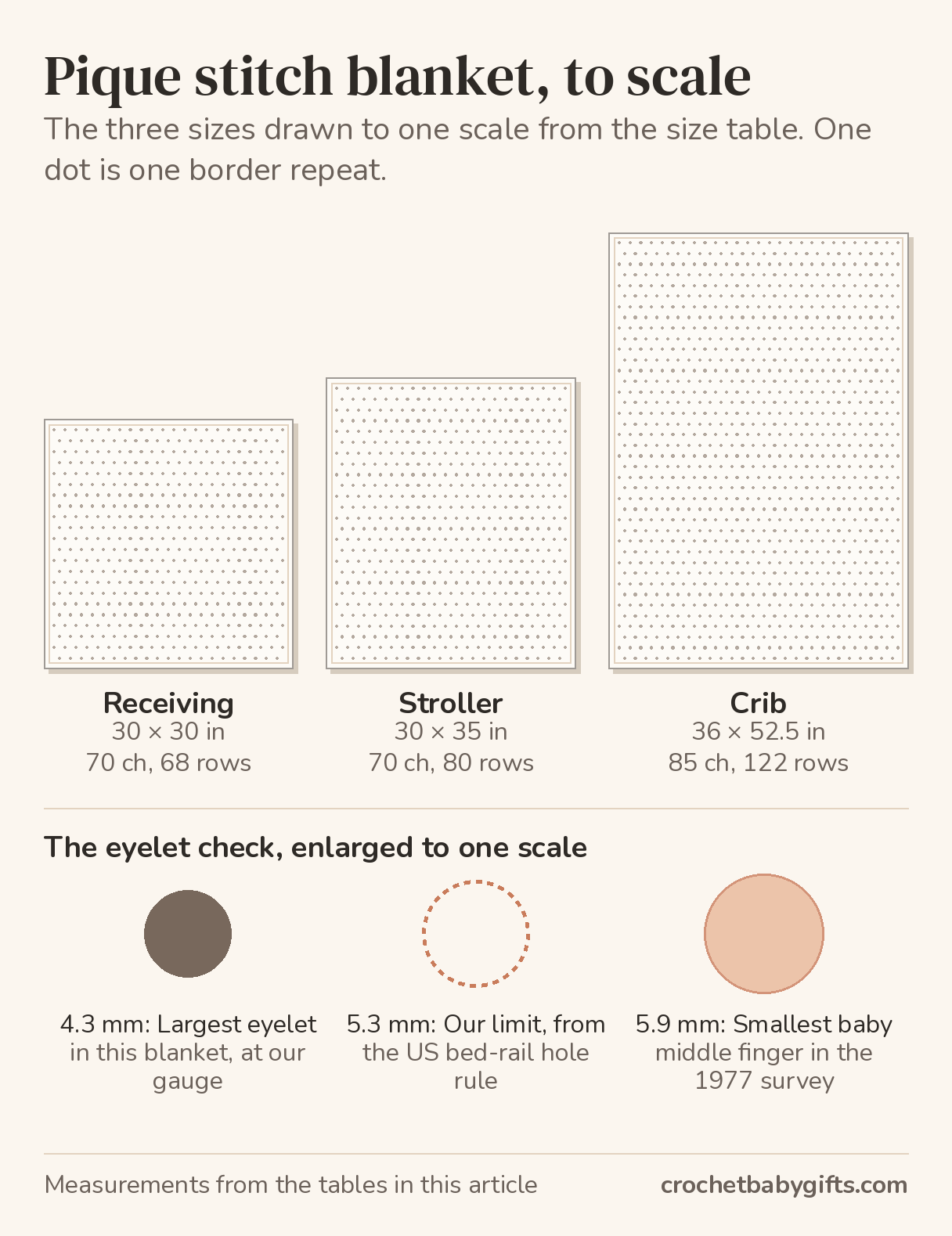
Three sizes from our crochet baby blanket size chart, with a finished size of about 30 (30, 36) by 30 (35, 52.5) in. The finished size includes the border. The border adds about 0.6 in (1.6 cm) to each edge. Border sides are the single crochets between the corners on the top and bottom, then on each side.
Which size, quickly: for a gift, make the stroller size. It is the one our size chart suggests when you do not know which to pick: useful past the newborn weeks and small enough to carry in a bag.
A blanket is for cuddles, the pram and floor time with an adult watching. It is not for a sleeping baby under 12 months: see made for a baby.
How small the eyelets are
The pique stitch works a half-made double crochet and a half double crochet into the same stitch and closes them together. Heart Hook Home’s tutorial describes it as about as tall as a double crochet and twice as wide, and says it works over any number of chains. Neighbouring clusters lean on each other and leave a small eyelet at the base between them: the rows of little holes in the picture. No stitch is skipped and there is no chain space, so nothing in this blanket is bigger than those eyelets.
How small is small enough? We could not find a hole size for blankets from any safety body. Knots of Love, a charity that gives blankets to newborn intensive care units, asks makers not to use lace or patterns with holes, because tiny fingers, toes and medical tubes can catch in them. For a number we use two US government figures. In a 1977 US survey of infants, the smallest middle finger measured was 5.9 mm across at the first joint. And a US safety rule for the rigid parts of bed rails allows no hole between 0.210 in and 0.375 in across, the sizes that can trap a small body part. Neither is a blanket standard, so the limit is our own choice: our limit is 5.3 mm, the smaller of those two sizes.
| Opening or finger | Across |
|---|---|
| Largest eyelet in this blanket, at our gauge | about 4.3 mm |
| Our limit, from the US bed-rail hole rule | 5.3 mm |
| Smallest baby middle finger in the 1977 survey | 5.9 mm |
At our gauge each cluster is about 10.7 mm wide. On frames of the video the eyelets measure about a quarter to a third of the cluster spacing and the biggest about 0.4 of it, so the largest eyelet is about 4.3 mm across. The frames are small, so treat that as an estimate. At the video’s 6 mm gauge it would be about 5.1 mm, just under our limit, which is why this pattern uses a 5 mm hook.
The eyelets grow with the stitch: if your swatch has fewer than 8 clusters to 4 in, go down a hook size. Then push a fingertip at the swatch, lying flat. If it goes through, the stitches are too loose for a baby blanket.
What you need
Every tool our patterns use is on the Crochet essentials page.
- Worsted (#4) yarn, soft and machine washable, the amount in the size table. Any machine-washable yarn of that weight works. Buy it all from one dye lot.
- A 5 mm (H-8) crochet hook for the blanket, and a 6 mm (J-10) hook for the foundation chain only. The hook size chart gives the letters.
- Four locking stitch markers, one for each corner of the border.
- A tape measure, a blunt tapestry needle and scissors.
Gauge and abbreviations
Gauge: about 9.5 clusters and 9.5 rows to 4 in (10 cm) on a 5 mm (H-8) hook, and about 16 sc and 19 rows of sc to 4 in on the same hook. We have not measured this on the blanket yet. It is a planning figure: the video designer publishes 8 clusters and 8 rows to 4 in on a 6 mm hook, and we scaled that, and our usual worsted single crochet gauge, to the smaller hook. Every size on this page is worked out from it, so make the swatch in section 1 of the pattern first.
US crochet terms throughout. The UK name is in brackets.
- ch: chain. sl st: slip stitch. st(s): stitch(es).
- sc: single crochet (UK: double crochet, dc).
- cl: pique cluster. Yarn over, put the hook into the stitch, yarn over and pull up a loop (3 loops on the hook), yarn over and pull through 2 loops (2 left). Yarn over, put the hook into the same stitch, yarn over and pull up a loop (4 loops), yarn over and pull through all 4. In UK terms it is a half-made treble and a half treble, closed together.
- Row end: the side of the first or last cluster of a row, where the border goes along the sides.
- 70 (70, 85): the first number is for the receiving size, the ones in brackets for the stroller and crib sizes.
The video
Maisie and Ruth’s video teaches the pique stitch slowly, and that is the part to watch. The blanket in the video is 24 × 28 inches from a chain of 47, with a half double crochet border and a pompom on each corner. Ours uses the same stitch with our own sizes, a turning chain that does not count, a counted single crochet border and no pompoms.
- How loose to make the foundation chain, at 3:48. We also use a hook one size bigger for it.
- The pique cluster, step by step, from 4:58, counting the loops on the hook.
- The cluster again, slowly, from 6:15.
Video: Maisie and Ruth, “How to Crochet an EASY Baby Blanket (A QUICK, 1-Row Repeat for you!)”, 2021, about 27 minutes. The stitch she teaches; the sizes, counts and border on this page are our own.
The pattern
Every row is clusters only. The 2 chains you skip at the start of row 1, and the ch 2 at the start of every later row, do not count as a stitch, so every row has the same number of clusters and there is one number to count.
1. Swatch
With the 6 mm hook, ch 19 loosely, change to the 5 mm hook and work 17 clusters in every row, as rows 1 and 2 of the blanket below, until the swatch is about 5 in tall. Lay it flat without stretching it and count the clusters in 4 in across the middle, then the rows in 4 in up the middle.
If you count fewer clusters than our gauge, your blanket will come out bigger, and if you count more, smaller. Either way, keep the eyelet check in mind, then use our counts or work your own: clusters = body width × your clusters in 4 in ÷ 4, rounded to a number that is 2 more than a multiple of 3.
2. The blanket
- Foundation: with the 6 mm hook, ch 70 (70, 85) loosely. Change to the 5 mm hook.
- Row 1: cl in 3rd ch from hook and in each ch across. [68 (68, 83) cl]
- Rows 2–68 (2–80, 2–122): ch 2 (does not count), turn, cl in each st across. [68 (68, 83) cl]
Work the first cl of each row into the first st, right at the base of the ch 2, and the last cl into the last st. Never work into the turning chain.
Every 10 rows, count the clusters in the row you just made and measure the width at the bottom, middle and top. They should be within half an inch of each other. The tape measure decides the length: stop when the blanket measures its finished length in the size table, less 1.3 in for the two border edges. Do not fasten off.
3. Border, round 1
The border goes once round all four sides, with 3 sc in each corner. A cluster is wider than a single crochet, so along every side the border puts 5 sc over every 3 clusters or 3 row ends. The corners take the first and last cluster of the top and bottom, and the ends of the first and last row, so each side is worked into the rest. Put a marker in the centre sc of each corner.
- Top: ch 1, turn, 3 sc in first cl, [2 sc in each of next 2 cl, sc in next cl] 22 (22, 27) times, 3 sc in last cl. [110 (110, 135) sc between the corners]
- First side: starting at the end of the second-to-last row, [2 sc in each of next 2 row ends, sc in next row end] 22 (26, 40) times, ending at the end of row 2. [110 (130, 200) sc]
- Bottom: 3 sc in the first ch that holds a cl, [2 sc in each of next 2 ch, sc in next ch] 22 (22, 27) times, 3 sc in the last ch that holds a cl. [110 (110, 135) sc between the corners]
- Second side: starting at the end of row 2, [2 sc in each of next 2 row ends, sc in next row end] 22 (26, 40) times, ending at the end of the second-to-last row. [110 (130, 200) sc]
- Join: sl st in the first sc. [452 (492, 682) sc]
Along the bottom, work into the free loops of the foundation chain, under the clusters of row 1. To find a row end, look for the side of the end cluster: put the hook under the outside strand of it.
Count each side before you join. If a side is a few stitches off, take out the last few and space them again. It is quicker now than after round 3.
4. Border, rounds 2 and 3
- Rnd 2: ch 1, sc in each sc, with 3 sc in the centre sc of each corner; join with a sl st in the first sc. [460 (500, 690) sc]
- Rnd 3: as round 2. [468 (508, 698) sc]
Each round adds 2 sc to every side, so 8 in all. Move the corner markers up as you go.
5. Finishing
Fasten off. Weave in every tail with the tapestry needle: through the stitches one way, back the other way, then a third way, and trim it close. Changing direction is what holds it in the wash.
Made for a baby
- Not for a sleeping baby under 12 months. Use this one for cuddles, the pram and floor time with an adult watching. Our crochet blanket safety guide has the detail.
- No pompoms, tassels or fringe, and no buttons or beads. Anything attached can come off as a small piece. Our corners are finished by the border, which is part of the blanket.
- Small holes only. The largest eyelet is under our limit at our gauge; check your own swatch as in how small the eyelets are.
- Weave in the ends securely. A loose thread or hair can wind round a baby’s finger or toe and cut off the blood flow, which doctors call a hair tourniquet. Weave each tail in three directions so it cannot work loose.
- Wash it before you give it. Newborn skin is sensitive, and you do not know who has handled the yarn. Our guide to washing a crochet baby blanket has the settings.
The sources for each point are on our handmade baby gift safety checklist.
Yarn and time
We plan 1.33 yards a square inch of finished blanket: the worsted figure for double crochet from our yarn guide, 0.95, times 1.4 for a raised texture. That runs on the cautious side. The video designer’s own published amounts work out at about 0.9 yards a square inch for her blanket on a 6 mm hook. A smaller hook makes a denser fabric that uses more yarn, so we keep the cautious figure.
The receiving size is about 6,000 stitches, border included. Crochet for 10 minutes, count your clusters, and you can work out your own time.
If something goes wrong
The blanket is getting narrower. The first cluster of a row is being missed. Work it into the first st, right at the base of the ch 2.
The blanket is getting wider. A cluster is going into the turning chain at the end of a row. The ch 2 does not count, so skip it.
The bottom edge is tighter than the rest. The foundation chain was too tight. The cluster is wide, so the chain must be loose: make it with the 6 mm hook.
The eyelets look big. Your stitches are looser than our gauge. Count the clusters in 4 in; if there are fewer than in the eyelet check, start again a hook size smaller.
The border ruffles or pulls in. Your single crochet is narrower or wider than ours, compared with your clusters. If a side ruffles, take it back and work a plain sc in place of one of the 2 sc in some of the repeats; if it pulls in, add an sc in some repeats. Keep both sides of the blanket the same.
Frequently asked questions
What is the pique stitch? A cluster made of a half-finished double crochet and a half double crochet in the same stitch, closed together. It makes a pebbly fabric with small eyelets, and every row is the same, which is why it is called a one-row repeat.
Does the blanket have a right side? The video designer calls the stitch fully reversible. The border is the same on both sides too.
Can I add pompoms or tassels to the corners? We do not recommend it. They can come off and be swallowed, which is why infant booties with pompoms have been recalled. The border already finishes the corners.
Can I use DK or chunky yarn? Yes, with your own swatch and counts. Check the eyelets as above: the largest is about 0.4 of the width of one cluster, so the looser the stitch, the bigger it is.
Is it a good first blanket? It suits a beginner who can already make a chain and a double crochet. If you have never crocheted, start with our beginner baby blanket in half double crochet.
See also
- How to crochet a baby blanket for beginners, a half double crochet blanket in four sizes
- Crochet baby blanket size chart, for every standard size
- How much yarn for a baby blanket, for any size, stitch and yarn weight
- The best yarn for baby blankets, soft, washable and safe
- Are crochet blankets safe for babies?, before you give it
- How to wash a crochet baby blanket, the settings and the drying