Crochet Rose Car Charm: Free Pattern for Your Rearview Mirror
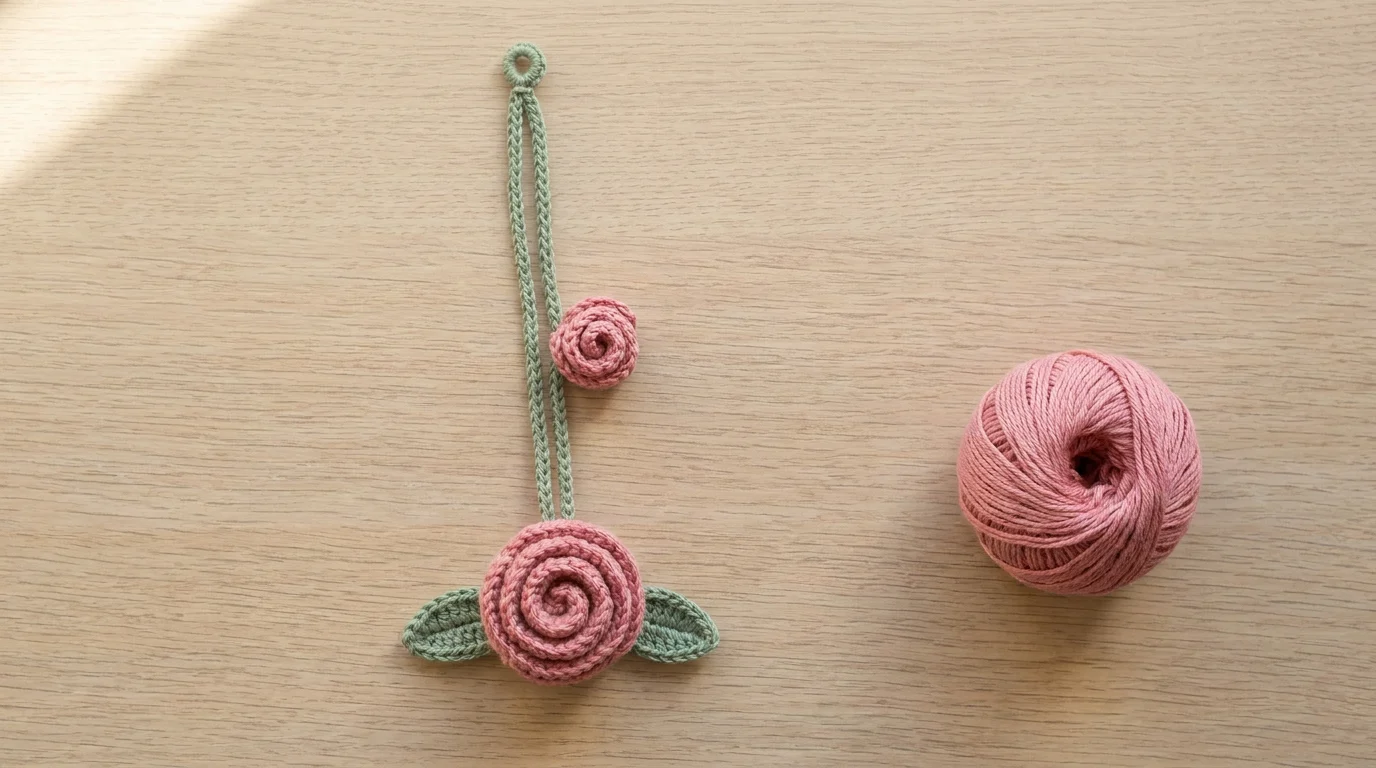
Crochet one long strip with eleven petals along it, roll it up into a rose, make a smaller bud and two leaves the same way, and hang all of it from the mirror on a slip-stitch cord. Every piece is worked flat in rows; there is no working in the round and no stuffing. In DK yarn on a 4 mm hook the rose is about 5½ cm across and the charm hangs about 14½ cm below the mirror.
Download the free printable PDF: every row with its stitch count, all 8 diagrams and the safety notes, ready to print. No sign-up.
This is our own design, and it has not yet been test-made from this page. The stitch counts are checked by a script against every row, and the sizes are estimates worked out from a published DK gauge, so the first thing to check is your own rose against the size table.
The charm at a glance
| What | This charm |
|---|---|
| Pieces | 1 rose, 1 rosebud, 2 leaves, 1 cord |
| Stitches | Chain, slip stitch, single crochet, half double crochet, double crochet |
| Yarn | DK (#3), two colours: one for the flowers, one green for the leaves and cord |
| Hook | 4 mm (G-6) |
| Construction | Flat strips rolled into flowers, sewn to a folded cord |
| Time | One sitting. The rose strip is 45 stitches plus 11 petals |
| Skill level | A first project after a chain and a single crochet; this page explains the rest |
How the rose works
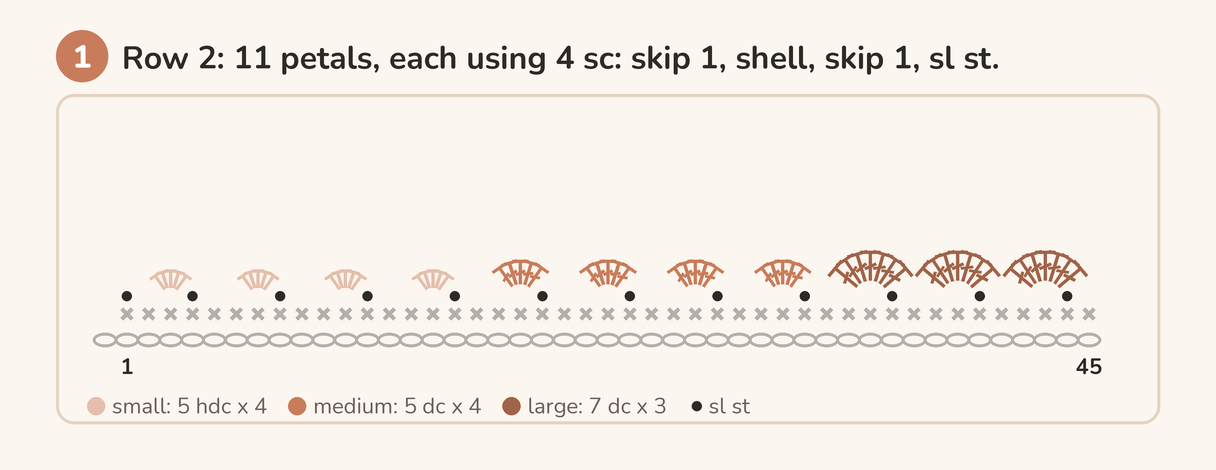
The rose is a strip. Row 1 is a line of single crochet; row 2 turns that line into eleven petals, small ones first, then medium, then large. Rolled up from the small end, the small petals make the tight centre and the large ones open round the outside, the way a real rose does. The petals only stay in place because every one of them uses exactly four stitches of row 1, so the counts below are the whole pattern.
Sizes
| Piece | Size (estimate) |
|---|---|
| Rose | about 5.5 cm (2 in) across |
| Rosebud | about 3.5 cm (1.5 in) across |
| Leaf | about 5 cm (2 in) long, about 2 cm (0.75 in) wide |
| Cord | about 38 cm (15 in) before folding |
| Hangs below the mirror | about 14.5 cm (5.75 in) |
These are worked out, not measured: from the DK gauge on a yarn label (16 single crochet in 4 inches on a 4 mm hook), the length of each strip, and the thickness of DK yarn. If your rose comes out bigger or smaller, the charm still works; for a shorter drop, make the cord with fewer chains (step 6).
Before you hang it
- Check the rules where you drive. Minnesota bans any object hanging between the driver and the windshield. California, New York, Pennsylvania, Illinois and the UK ban objects that block or reduce the driver’s view, and courts there have looked at how much of the view an object actually covered. Hang one small charm, keep it close to the mirror, and take it down if it swings into your view or your state forbids it.
- Only from the front mirror. Never hang it on a car seat, a carrier handle or a headrest, or anywhere a baby can reach. The American Academy of Pediatrics advises against adding anything to a car seat that did not come with it, and loose objects can be thrown about in a crash.
- It will fade, not melt. Car dashboards in direct sun can reach about 69 °C (157 °F) within an hour. Yarn does not melt at that: polyester melts above 250 °C, and acrylic and cotton break down rather than melt, far above anything a car reaches. Sunlight does fade colour, so expect a bright rose to pale over a summer.
- Is there a camera behind your mirror? Many newer cars have one. Check your car’s manual before hanging anything there.
What you need
Every tool our patterns use is on the Crochet essentials page.
- DK (#3) yarn in two colours: a rose colour, and a green for the leaves and the cord. Small amounts: one 50 g ball of each is far more than the charm needs, and scraps work.
- A 4 mm (G-6) crochet hook. The hook size chart gives the letters.
- A blunt tapestry needle for rolling and sewing, and scissors.
Abbreviations
US crochet terms throughout. The UK name is in brackets.
- ch: chain.
- sl st: slip stitch.
- sc: single crochet (UK: double crochet, dc). Put the hook into the stitch, yarn over and pull up a loop, yarn over and pull through both loops.
- hdc: half double crochet (UK: half treble, htr). Yarn over, put the hook into the stitch, yarn over and pull up a loop, yarn over and pull through all 3 loops.
- dc: double crochet (UK: treble, tr). Yarn over, put the hook into the stitch, yarn over and pull up a loop, then twice yarn over and pull through 2 loops.
- Back bump: the little ridge on the back of a chain. Working into it leaves a neat edge.
The pattern
1. The rose strip
In the rose colour, make a slip knot and ch 46. Row 1: sc in the 2nd ch from the hook and in each ch to the end. Turn. [45 sc]
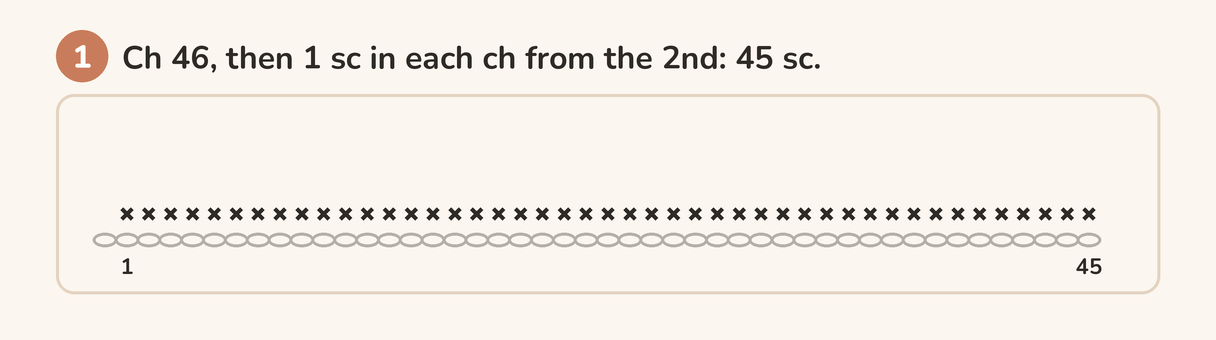
Count the stitches now. Every petal in the next row uses four of them, so a strip that is one stitch out leaves the last petal short.
2. The petals
Row 2: ch 1 (it does not count as a stitch) and sl st in the first sc. Then:
- Small petals: [skip 1 sc, 5 hdc in the next sc, skip 1 sc, sl st in the next sc] 4 times.
- Medium petals: [skip 1 sc, 5 dc in the next sc, skip 1 sc, sl st in the next sc] 4 times.
- Large petals: [skip 1 sc, 7 dc in the next sc, skip 1 sc, sl st in the next sc] 3 times.
The last sl st goes into the last sc. [11 petals, all 45 sc used] Fasten off and leave a 30 cm (12 in) tail for sewing.
3. Roll and sew the rose
Start at the end with the small petals, the end you started row 2 from. Roll the strip up on itself with the single crochet edge at the bottom, keeping that edge level so the rose stands flat. Roll the small petals tightly to make the centre, then roll more loosely so the large petals open out.
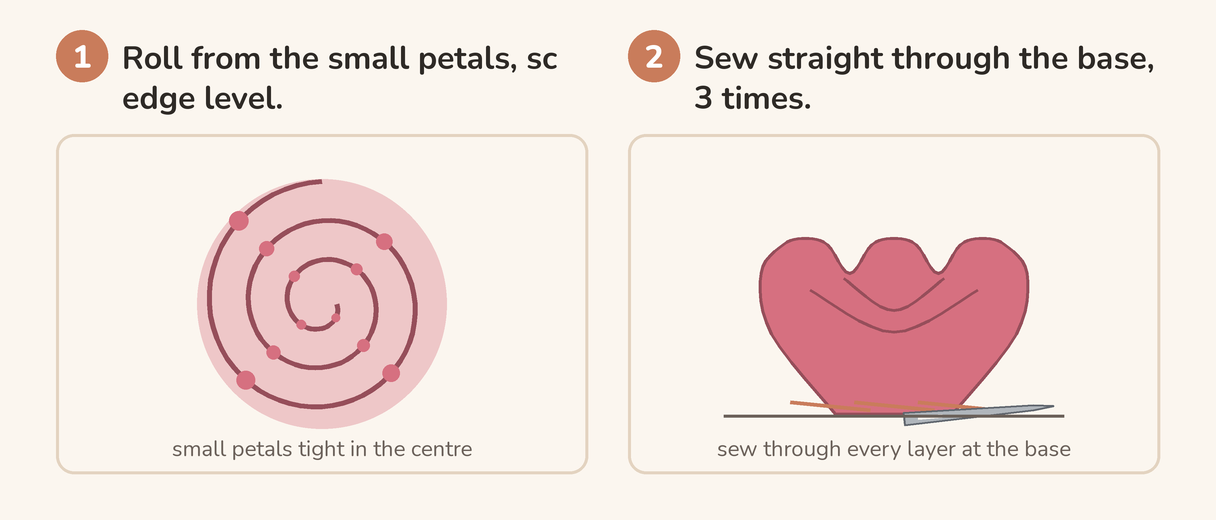
Thread the tail on the needle and push it straight through the bottom of the roll, through every layer, then back the other way at a right angle. Do this twice more round the base. Pull firmly: the base should feel solid when you squeeze it. Keep the tail for sewing the rose on.
4. The rosebud
In the rose colour, ch 18. Row 1: sc in the 2nd ch from the hook and in each ch to the end. Turn. [17 sc]
Row 2: ch 1 and sl st in the first sc, then [skip 1 sc, 5 hdc in the next sc, skip 1 sc, sl st in the next sc] 4 times. [4 petals, all 17 sc used] Fasten off with a 20 cm (8 in) tail.
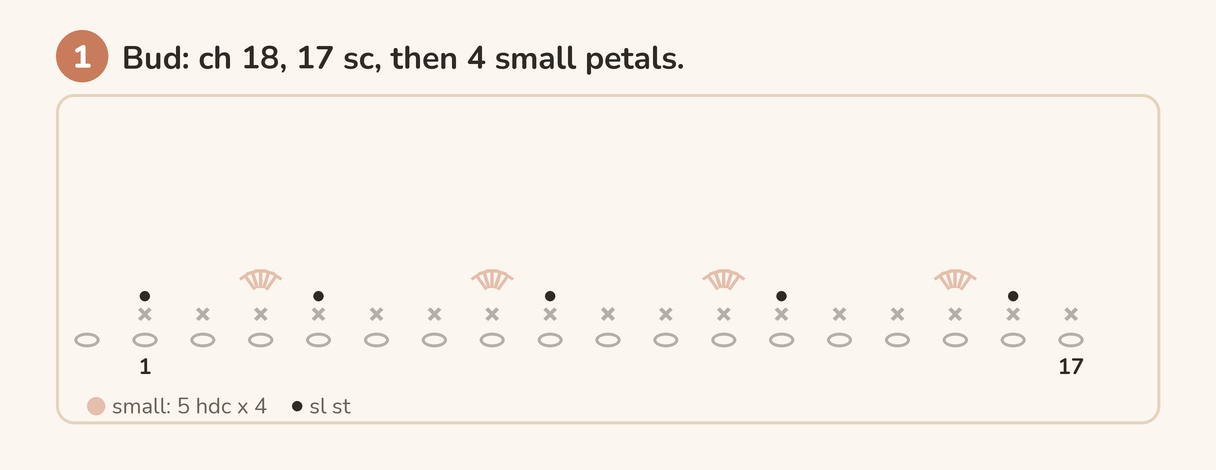
The bud is the first four petals of the rose on their own. Roll it tightly from the start of row 2 and sew the base the same way.
5. The leaves
Make 2. In green, ch 9. Working in the back bump of each chain: sl st in the 2nd ch from the hook, sc in the next ch, hdc in the next ch, dc in each of the next 2 ch, hdc in the next ch, sc in the next ch, 3 sc in the last ch. Turn the work round and continue along the other side of the chain: sc in the next ch, hdc in the next ch, dc in each of the next 2 ch, hdc in the next ch, sc in the next ch, sl st in the next ch. [17 sts] Fasten off with a 20 cm (8 in) tail.
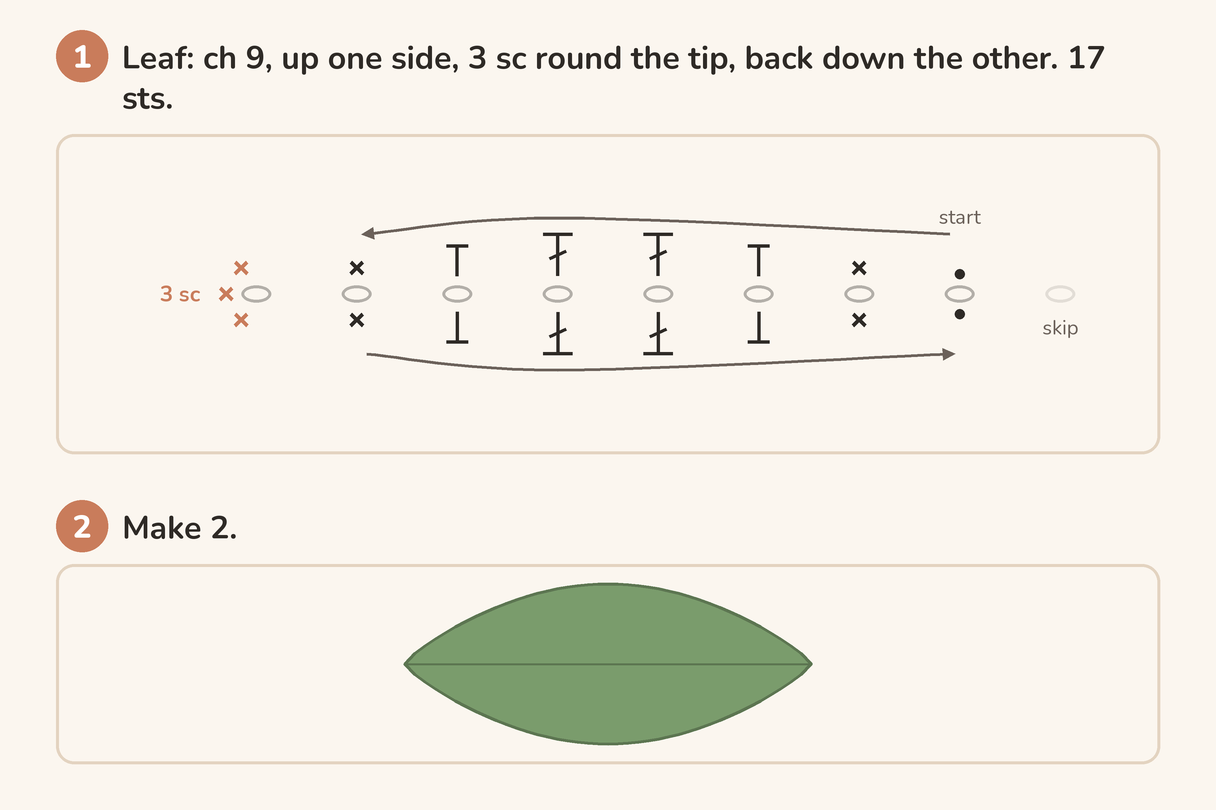
The 3 sc at the end turn the corner and make the tip. The tall stitches in the middle make the leaf widest in its middle third.
6. The cord
In green, ch 61. Sl st in the back bump of the 2nd ch from the hook and of every ch to the end. [60 sl st] Fasten off with a 15 cm (6 in) tail, and weave the starting tail in.
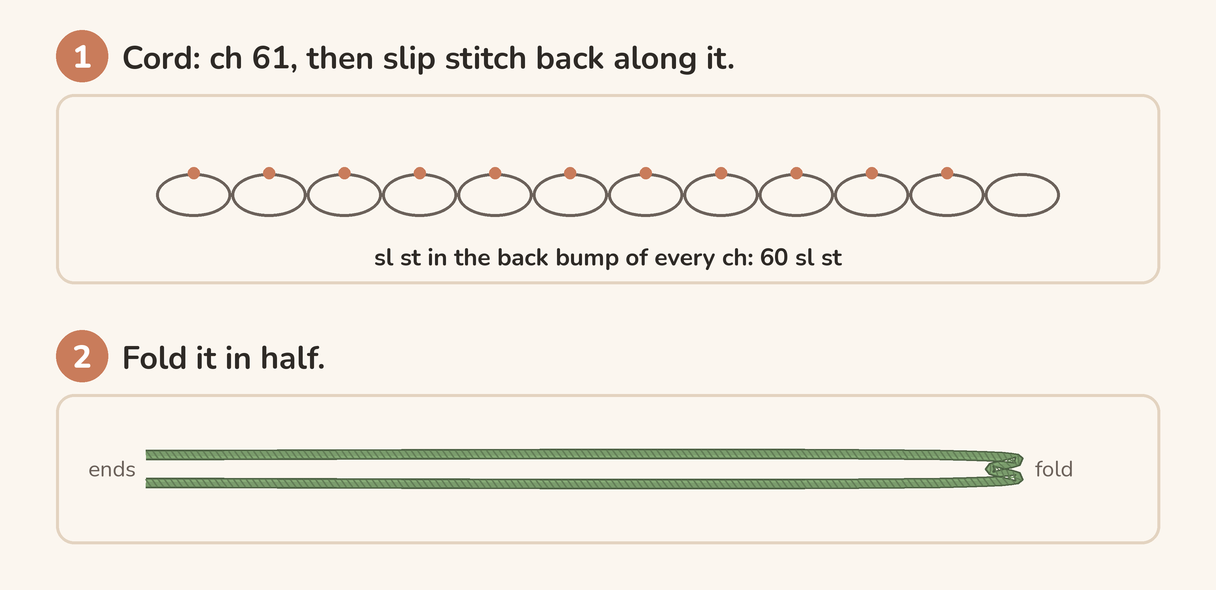
The slip stitches make the chain firm so it does not stretch when the rose hangs from it. For a shorter charm, chain fewer: every 10 chains you leave out raises the rose by about 3 cm (1¼ in), because the cord is used doubled.
7. Put it together
Fold the cord in half. Lay both ends against the back of the rose base and sew them on with the rose’s tail, through the base several times. Sew the two leaves to the back of the rose so they point out to either side, just below the middle. Sew the bud to one strand of the cord about 4 cm (1½ in) above the rose. Sew every piece on firmly, through the base several times, so nothing small can come loose. Weave in every tail.
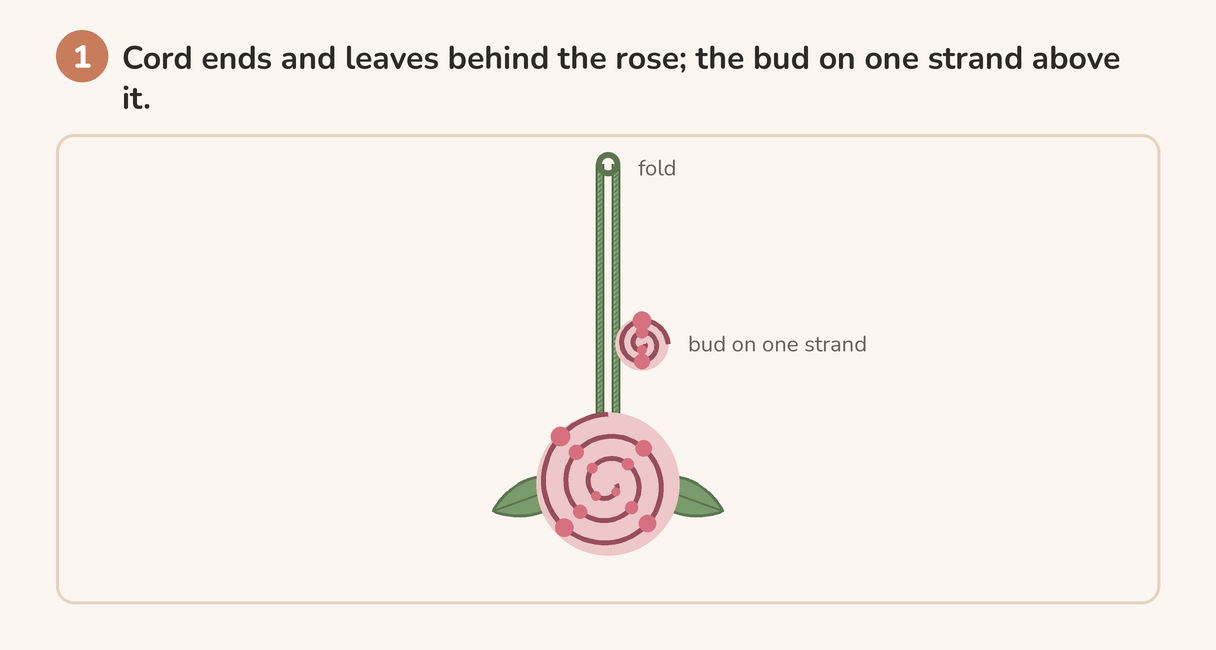
8. Hang it with a lark’s head knot
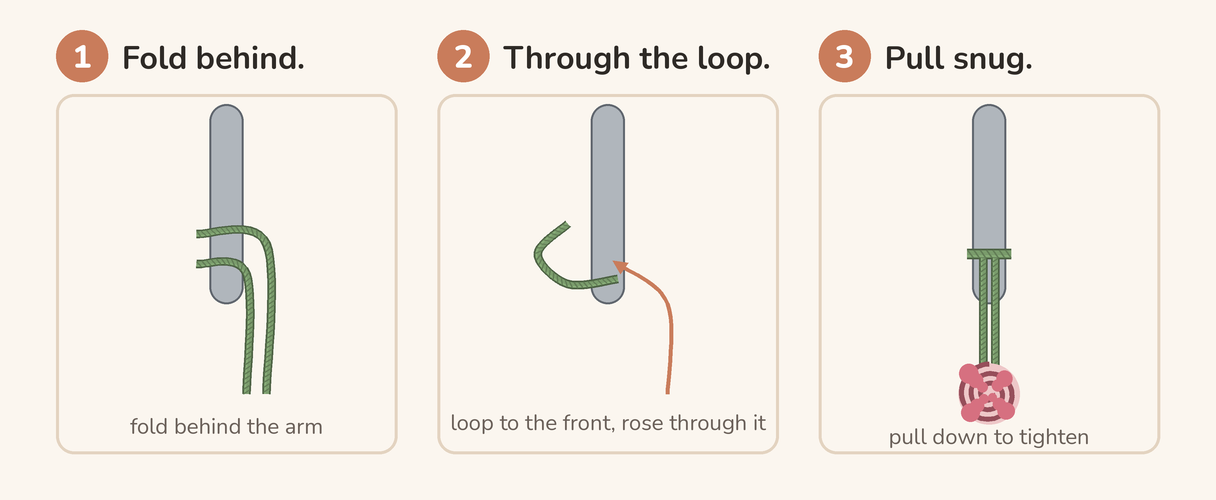
Hold the fold of the cord against the back of the mirror’s arm, bring the loop round to the front, and pass the rose, bud and both strands through the loop. Pull the rose down gently so the loop tightens round the arm. There is nothing to tie, and it slides off the same way.
If something goes wrong
The last petal is short, or there is a stitch left over. Row 1 does not have 45 sc. Count it, and pull back to fix it rather than squeezing the petals: each one needs exactly four stitches.
The rose looks flat, like a spiral. It was rolled too loosely at the start. Re-roll with the small petals tight, then loosen.
The rose leans or tips. The single crochet edge was not kept level while rolling, so the base is a cone. Unroll and roll again with the bottom edge flat on the table.
It hangs too low. Make a new cord with fewer chains (step 6), or tie a loose overhand knot in the doubled cord just under the mirror.
Frequently asked questions
How long does it take? One sitting. The rose is 46 chains, 45 single crochet and 11 petals; the bud, the leaves and the cord are smaller.
Can I make it in other colours? Yes. Any rose colour works; our baby blanket colour combinations guide has palettes that work in small pieces too.
Can I hang it in a car that carries a baby? Only from the front rear-view mirror, never on the car seat, its handle or a headrest, and never within a baby’s reach. See before you hang it.
Can I make a bigger rose? Use a thicker yarn and a bigger hook with the same counts, or add petals: every extra petal needs 4 more stitches in row 1, so add 4 chains for each.
This is an original pattern by Crochet Baby Gifts. You may make and sell the charm; please do not republish the pattern. Crochet terms are in US English.