Baby Hat Size Chart and How Much Yarn Each Size Needs
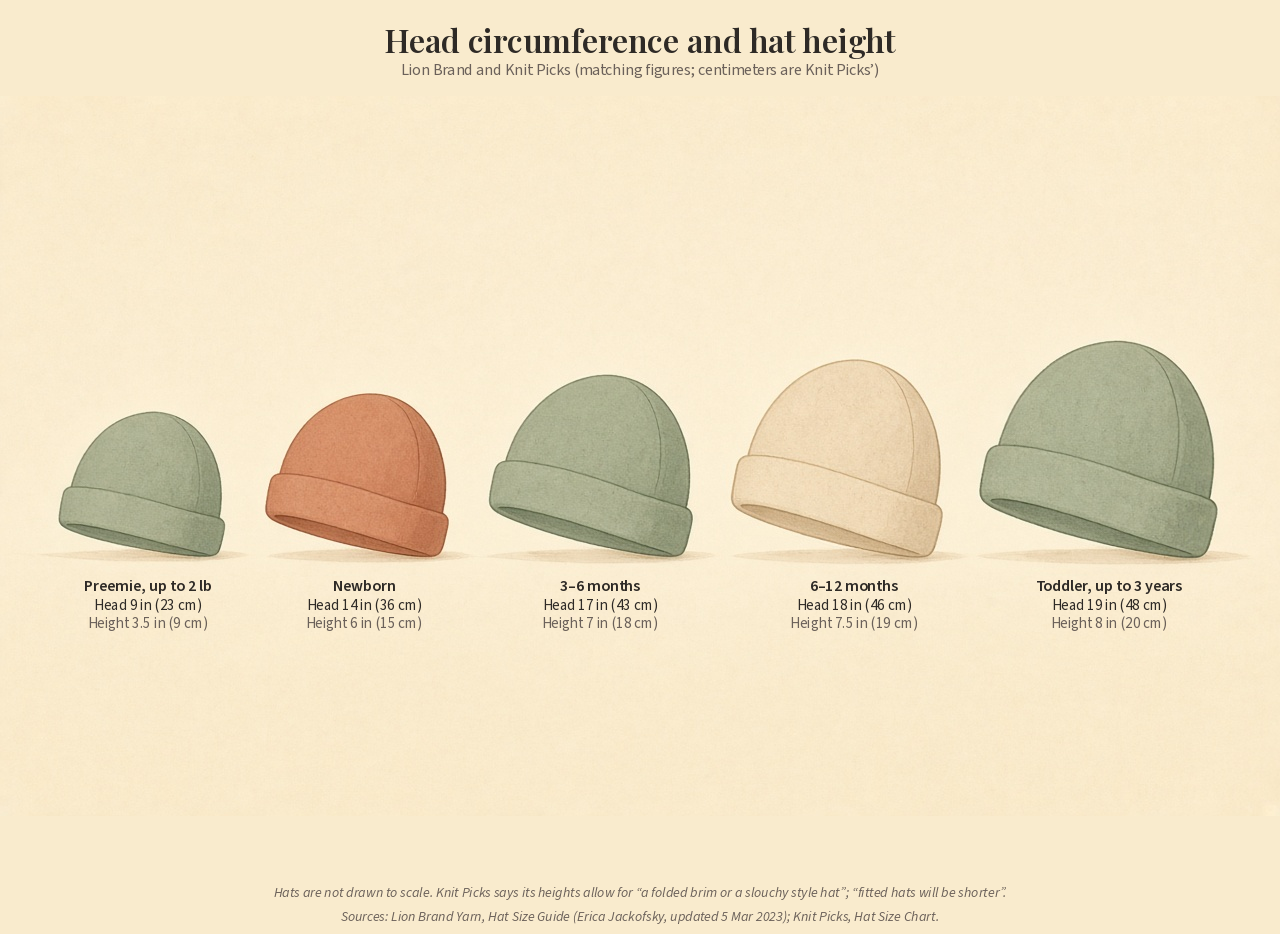
The short answer on size: Lion Brand and Knit Picks both list a head of about 14 in (36 cm) for a newborn, 17 in (43 cm) for 3–6 months, 18 in (46 cm) for 6–12 months and 19 in (48 cm) for a toddler, with hat heights of 6–8 in. Other charts differ, so measure the head if you can.
The short answer on yarn: it varies a lot by pattern. Free crochet patterns publish these amounts for plain or lightly textured hats (mostly beanies, plus one bonnet and two eared or earflap hats):
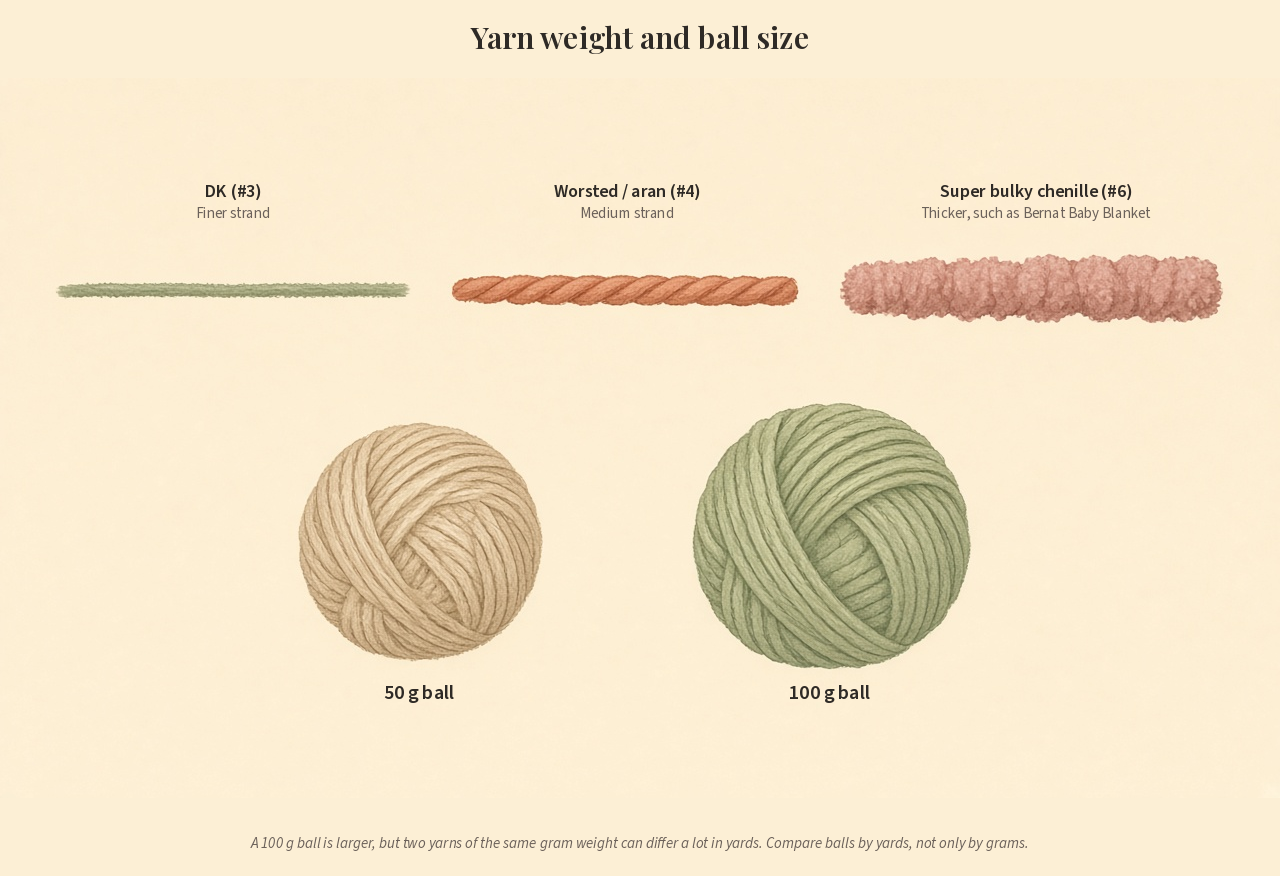
- DK (#3): about 55–78 yd for a newborn, 58–135 yd for 3–6 months and 72–175 yd for 6–12 months.
- Worsted or aran (#4): about 55–85 yd for a newborn, 80–140 yd for 6–12 months and 90–175 yd for a toddler.
- Super bulky chenille (#6), such as Bernat Baby Blanket: about 30–45 yd from newborn to 6–12 months in the one pattern that publishes it.
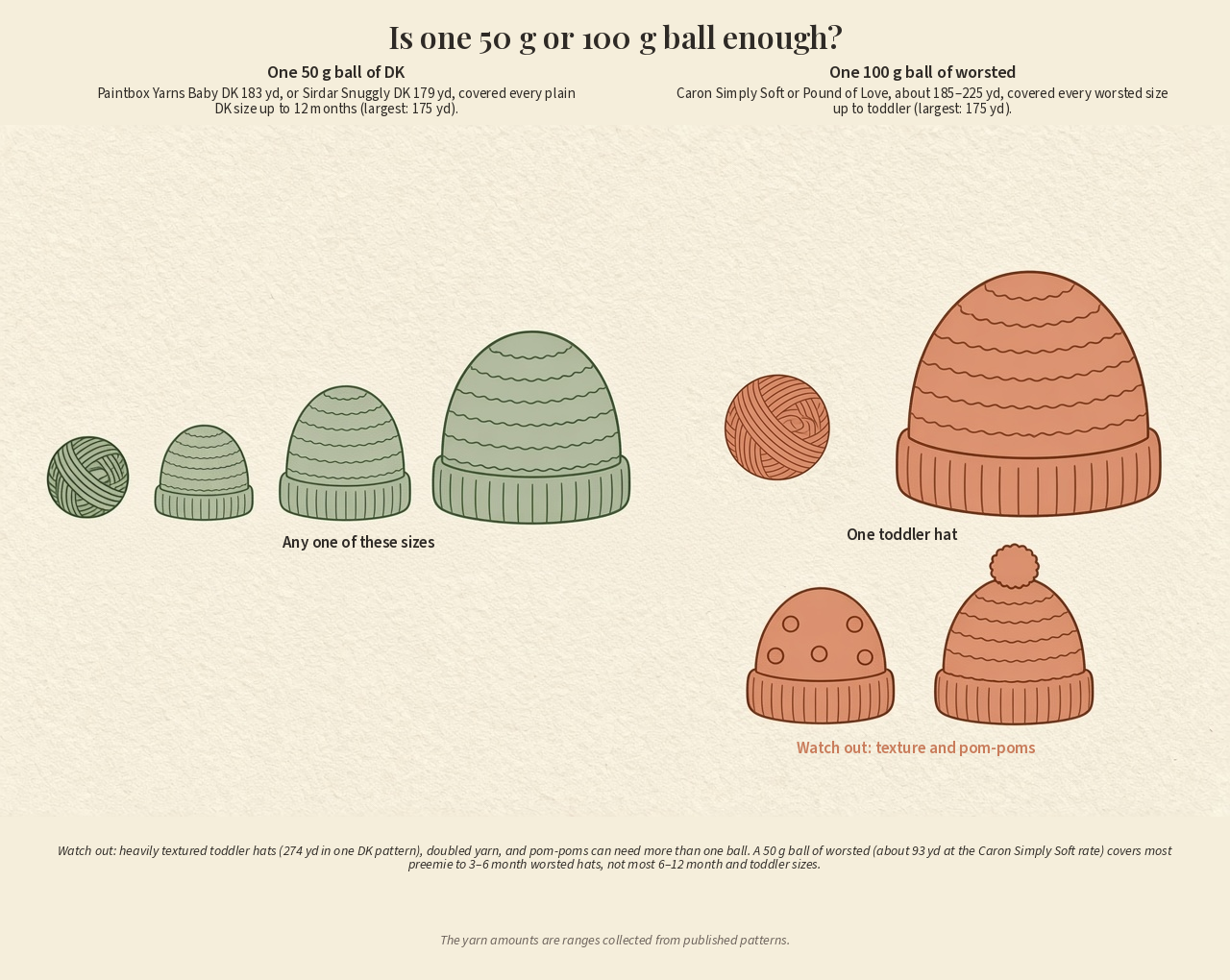
One 50 g ball of Paintbox Yarns Baby DK or Sirdar Snuggly DK (179–183 yd) covered every plain DK size up to 12 months in these patterns, and 100 g of worsted (about 185–225 yd) covered every worsted size up to toddler. Heavy texture, doubled yarn and pom-poms push a hat past one ball. Every figure below is cited. The yarn amounts are ranges collected from published patterns.
Baby hat size chart: head size and hat height
Head circumference and hat height by size (Lion Brand and Knit Picks)
The two brands publish matching figures; centimeters are Knit Picks’.
| Size (Lion Brand / Knit Picks labels) | Head circumference | Hat height |
|---|---|---|
| Preemie, up to 2 lb / 1–2 lb | 9 in (23 cm) | 3.5 in (9 cm) |
| Preemie, up to 4 lb / 3–4 lb | 11 in (28 cm) | 4 in (10 cm) |
| Preemie, up to 5 lb / 4–5 lb | 12 in (30 cm) | 4.5 in (11 cm) |
| Preemie, up to 6 lb / 5.5–6 lb | 13 in (33 cm) | 5 in (13 cm) |
| Newborn | 14 in (36 cm) | 6 in (15 cm) |
| Baby, up to 6 months / 3–6 months | 17 in (43 cm) | 7 in (18 cm) |
| Baby, up to 12 months / 6–12 months | 18 in (46 cm) | 7.5 in (19 cm) |
| Toddler, up to 3 years / 12 months–3 years | 19 in (48 cm) | 8 in (20 cm) |
| Child, up to 10 years / 3–10 years | 19–20 in (Lion Brand) / 20 in, 51 cm (Knit Picks) | 8.5 in (22 cm) |
Sources: Lion Brand Yarn, Hat Size Guide (Erica Jackofsky, updated 5 Mar 2023); Knit Picks, Hat Size Chart. Knit Picks says its heights allow for “a folded brim or a slouchy style hat”, and “fitted hats will be shorter”.
Craft Yarn Council head circumference standard
| CYC size | Head circumference (in) | (cm) |
|---|---|---|
| Preemie | 9–12 | 23–30.5 |
| Baby | 14–16 | 35.5–40.5 |
| Toddler | 16–18 | 40.5–46 |
| Child | 18–20 | 45.5–51 |
| Tween | 20–22 | 51–56 |
Source: Craft Yarn Council Head Circumference Chart. CYC gives no ages and no hat heights. Its bands also leave a gap (nothing between 12 and 14 in) and overlap (Toddler and Child at 45.5–46 cm).
WHO median head size by age
| Age | Girls, 50th (cm) | Girls, 3rd–97th (cm) | Boys, 50th (cm) | Boys, 3rd–97th (cm) | 50th in inches, girls / boys (derived) |
|---|---|---|---|---|---|
| Birth | 33.9 | 31.7–36.1 | 34.5 | 32.1–36.9 | 13.3 / 13.6 |
| 3 months | 39.5 | 37.2–41.9 | 40.5 | 38.3–42.7 | 15.6 / 15.9 |
| 6 months | 42.2 | 39.7–44.6 | 43.3 | 41.0–45.6 | 16.6 / 17.0 |
| 9 months | 43.8 | 41.3–46.3 | 45.0 | 42.6–47.4 | 17.2 / 17.7 |
| 12 months | 44.9 | 42.3–47.5 | 46.1 | 43.6–48.5 | 17.7 / 18.1 |
| 18 months | 46.2 | 43.6–48.8 | 47.4 | 44.9–49.9 | 18.2 / 18.7 |
| 2 years | 47.2 | 44.6–49.8 | 48.3 | 45.7–50.8 | 18.6 / 19.0 |
| 3 years | 48.5 | 45.9–51.2 | 49.5 | 46.8–52.1 | 19.1 / 19.5 |
| 4 years | 49.3 | 46.7–52.0 | 50.2 | 47.5–53.0 | 19.4 / 19.8 |
| 5 years | 49.9 | 47.2–52.6 | 50.7 | 47.9–53.5 | 19.6 / 20.0 |
Source: WHO Child Growth Standards, head circumference-for-age percentile tables, birth to 5 years. Inches are cm ÷ 2.54 (derived). WHO publishes no preemie values in these tables.
Where the charts disagree
- Newborn: Yarnspirations’ Aneeta’s hat says newborn fits an 11–12 in (28–30.5 cm) head, against 14 in from Lion Brand and Knit Picks. That’s below WHO’s 3rd percentile at birth, so it may be a finished-hat size labelled as a head size.
- Around 6 months: Lion Brand and Knit Picks (17 in) match WHO’s median (16.6–17.0 in); CYC’s “Baby” band (14–16 in) is 1–3 in smaller.
- Toddler: CYC’s Toddler band (16–18 in) sits below WHO’s 2-year median (18.6–19.0 in).
- Hat height: Lion Brand and Knit Picks give 6 in for a newborn; EyeLoveKnots’ Dylan Claire Beanie, Willow Ridge and Stitch and Hound use 5 in. Knit Picks’ heights include a brim or slouch. DROPS’ Sweet Buttercup hat works to about 14, 15, 16 and 18 cm for 40/42, 44/46, 46/48 and 48/52 cm heads.
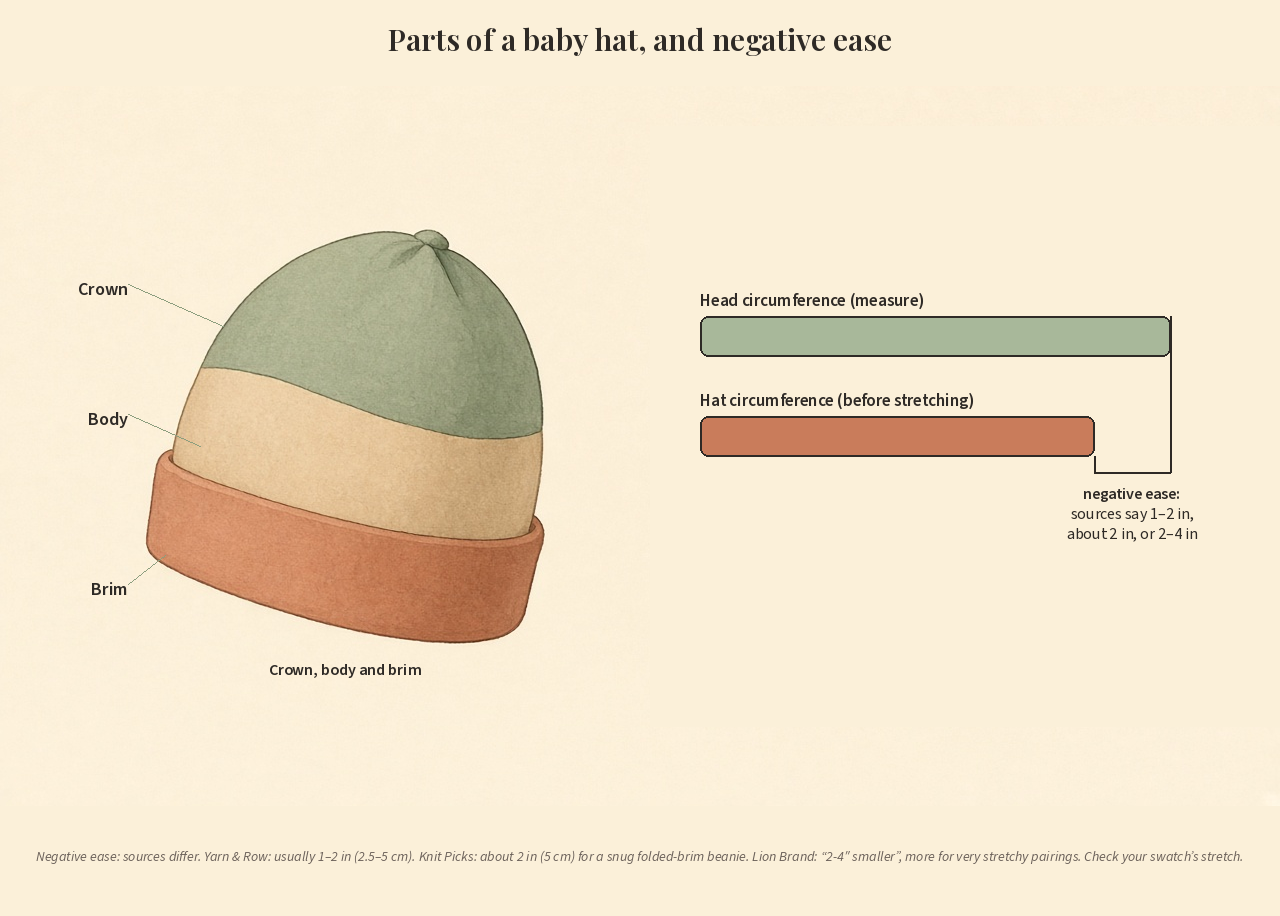
How much smaller than the head? (negative ease)
Sources disagree on how much smaller than the head a hat should be:
- Lion Brand Hat Size Guide: “2-4″ smaller”, more for very stretchy pairings.
- Knit Picks: about 2 in (5 cm) for a snug folded-brim beanie.
- EyeLoveKnots: 2 in “is the amount of stretch for acrylic, wool, and similar.”
- Yarn & Row: usually 1–2 in (2.5–5 cm).
Check whichever figure you use against your swatch’s stretch.
Yarn chart: how much yarn each hat size needs
Every figure below is cited. The yarn amounts are ranges collected from published patterns. Each cell shows yards, meters and grams; (n) is how many patterns gave a figure for that size. The head column repeats the WHO medians from the size chart.
| Size | Typical head (WHO median, girls–boys) | DK (#3) | Worsted / aran (#4) |
|---|---|---|---|
| Preemie | No WHO values. Lion Brand: 9–13 in by weight | 34–60 yd · 31–55 m · 9–16 g (n=4) | 40–55 yd · 37–50 m · 22–30 g (n=4) |
| Newborn | 33.9–34.5 cm (13.3–13.6 in) | 55–78 yd · 50–71 m · 15–21 g (n=3) | 55–85 yd · 50–78 m · 30–46 g (n=4) |
| 0–3 months | 39.5–40.5 cm (15.6–15.9 in) at 3 months | 46–110 yd · 42–101 m · 13–30 g (n=4) | 60 yd · 55 m · 32 g (n=1) |
| 3–6 months | 42.2–43.3 cm (16.6–17.0 in) at 6 months | 58–135 yd · 53–123 m · 16–37 g (n=5) | 65–110 yd · 59–101 m · 35–59 g (n=4) |
| 6–12 months | 44.9–46.1 cm (17.7–18.1 in) at 12 months | 72–175 yd · 66–160 m · 20–48 g (n=5) | 80–140 yd · 73–128 m · 43–76 g (n=5) |
| 12 months–toddler | 47.2–48.3 cm (18.6–19.0 in) at 24 months | 72–157 yd · 66–144 m · 20–43 g (n=2–3) | 90–175 yd · 82–160 m · 49–95 g (n=4) |
How this chart was built (derived): DK and worsted ranges are the lowest and highest per-size amounts in the crochet patterns under Sources (“one ball makes N hats” = ball length ÷ N), leaving out one heavily textured and one doubled-yarn outlier. Meters = yards × 0.9144. Grams use one reference yarn per column: DK = Paintbox Yarns Baby DK (3.66 yd/g); worsted = Caron Simply Soft (1.85 yd/g). For what the weight numbers mean, see our yarn weight chart for baby projects.
Chenille note: Super bulky chenille (#6), such as Bernat Baby Blanket: 30–45 yd (27–41 m, about 42–63 g) from newborn to 6–12 months, in the one pattern that publishes it (Crochet Dreamz, a hat with ears).
The spread within a size is bigger than the gap between DK and worsted, and the chenille note rests on one pattern, so treat it as a rough guide.
Why some sites say 85 yards for a 3–6 month DK hat
Yarn & Row’s FAQ says “about 85 yards”, which matches its knitted table. Its crochet table lists 110 yd (100 m) for the same size, so crocheters should use 110. Knits and Knots by AME’s weighed swatches found “crochet indeed used more yarn than knitting in general,” so don’t plan from knitting yardage.
How to use the chart
1. Start from the head, not the age label
Age labels don’t match between charts (see the size chart above). Measure the head if you can, then pick the nearest row.
2. Adjust for stitch and texture
- Taller stitches use less. In Craftsy’s swatch test, single crochet used the most; half double used 13 in less, double 38 in less again, treble only 2 in less than double.
- Single crochet, bobbles and ribbing push you up. Yarn & Row: single crochet or bobbles “need 10–30% more”, all-over ribbing “about 15% more” (adult example).
- Heavy texture can more than double it. Bella Coco’s textured Maplewood “Baby” size (14.5 in) lists 217 yd, against 58–135 yd for plain 3–6 month DK beanies: about 1.6–3.7 times (derived; different designers).
- Bonnets, earflaps and ears show no steady extra in the published patterns.
3. Mind the hook
In Crafty With Ashy’s worked blanket example, for the same finished size a larger hook used “about 30% less yarn”; for the same stitch count, the smaller hook used “about 17% less yarn” and the larger-hook piece came out “about 40% larger”.
4. Swatch, weigh, then work it out
A kitchen scale turns grams into yards. Divide the ball band’s yards by its grams to get yards per gram, then weigh your leftover or swatch and multiply.
5. Buy with a margin, and check the band
Some patterns include spare yarn (Itchin’ For Some Stitchin’: “approximately 10% extra”); HazelLoop advises assuming pom-pom yarn “isn’t in the total”. Compare balls by yards: Bernat Softee Baby holds about 2.59 yd/g and Paintbox Yarns Baby DK about 3.66 yd/g (derived), so 50 g of Softee Baby has about 30% fewer yards.
Is one 50 g or 100 g ball enough?
Comparing each ball’s length with the largest per-size amounts in the chart (derived, no pom-pom):
| Ball | Length | Covers | Watch out for |
|---|---|---|---|
| 50 g Paintbox Yarns Baby DK | 183 yd / 167 m | Every DK beanie and bonnet size up to 12 months (largest: 175 yd), plus Aneeta’s 18/24-month size (157 yd) | Heavily textured toddler hats (274 yd); adding a pom-pom |
| 50 g Sirdar Snuggly DK | 179 yd / 165 m | The same sizes, with 175 yd the tightest fit | The same |
| 50 g DROPS Baby Merino (labelled 5 ply / sport) | 191 yd / 175 m | All of the above. DROPS’ own Sweet Buttercup hat says “50 g for all sizes” | Heavily textured toddler hats |
| 100 g worsted (Caron Simply Soft or Pound of Love, by weight) | about 185–225 yd | Every worsted size in the chart (largest: 175 yd, toddler) | A toddler hat plus a large pom-pom (175 + 20–30 = 195–205 yd) is borderline at the Caron rate |
| 50 g worsted (Caron Simply Soft rate) | about 93 yd | Most preemie to 3–6 month worsted hats | Most 6–12 month and toddler sizes (100–175 yd) |
| 100 g Bernat Baby Blanket (chenille) | 72 yd / 65 m | Crochet Dreamz’s 30–45 yd hat | Any added trim |
Ball lengths are from the manufacturers’ pages. “Covers” means the ball’s yards are at least the published yards for that size.
Matching blanket? See how much yarn for a baby blanket.
Worked examples
Example 1: a 3–6 month DK beanie from one 50 g ball
- The chart gives 58–135 yd; plan for 135 yd if you’re working single crochet or ribbing.
- One 50 g ball of Paintbox Yarns Baby DK is 183 yd: 48 yd to spare.
- In grams, 135 ÷ 3.66 ≈ 37 g.
Result: one ball, with room for a swatch.
Example 2: a worsted toddler hat from a 100 g leftover
- The chart gives 90–175 yd of worsted for 12 months to toddler.
- 100 g of Caron Simply Soft (315 yd per 170 g, about 1.85 yd/g) ≈ 185 yd, which covers even 175 yd.
- Add a 3 in pom-pom, which Yarn & Row puts at 20–30 yd of worsted: 175 + 20 to 30 = 195–205 yd, more than 185.
Result: the hat fits; a large pom-pom might not, and leaving it off is safer anyway.
Example 3: will 40 g of Softee Baby make a 6–12 month hat?
- Bernat Baby Hat (Crochet), written for Softee Baby, says one 362 yd / 140 g ball makes 5 hats at 6–12 months: about 72 yd or 28 g each (derived).
- 40 g × 2.59 yd/g ≈ 104 yd, more than 72.
Result: enough for that pattern; other 6–12 month DK patterns list up to 175 yd.
Common mistakes
- Using knitting yardage (like Yarn & Row’s 85 yd FAQ answer).
- Comparing balls by weight. Two “DK” yarns differ by about 40% in yards per gram.
- Trusting an age label instead of a head measurement.
- Forgetting the trim, which is often outside a pattern’s total.
- Assuming one ball for every style. Lisa Auch’s doubled-DK earflap hat needs more than 100 g from 3–6 months up.
Safety notes
For questions about a particular baby, ask that baby’s health care provider.
Hat-specific guidance: indoors and sleep
- The AAP’s 2022 safe-sleep policy says: “Avoid overheating and head covering in infants,” and “it is advised not to place hats on infants when indoors except in the first hours of life or in the NICU.” HealthyChildren.org, the AAP’s parent site, says the same.
- NIH Safe to Sleep says to “keep baby’s head and face uncovered during sleep.”
- The NHS says to “remove hats and extra clothing as soon as you come indoors or enter a car, bus or train even if it means waking your baby.”
So treat a baby hat as outdoor, awake-time wear, and say so on the gift tag (see what to write on a handmade baby gift tag).
General children’s-product guidance: pom-poms, buttons and trims
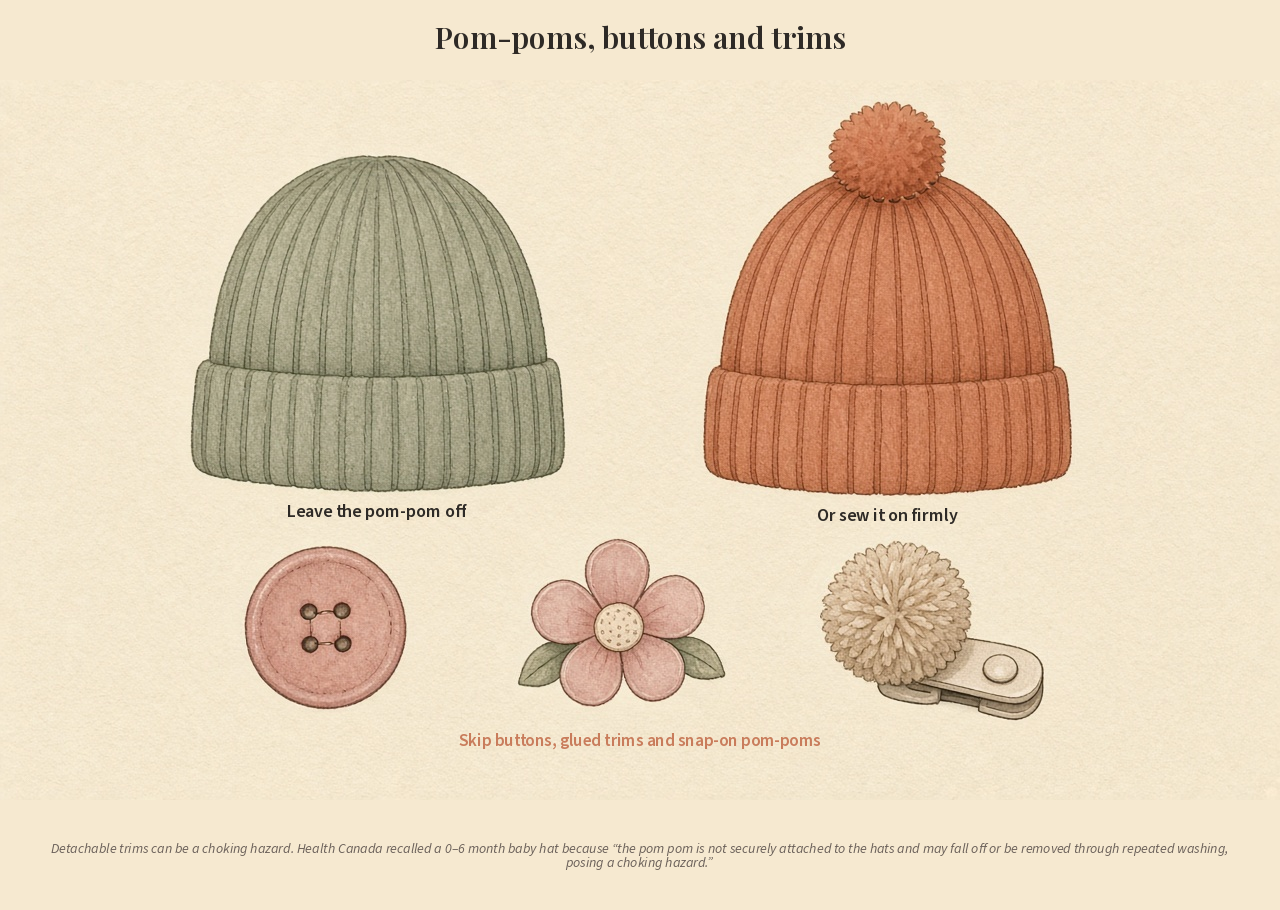
- The US small-parts rule (16 CFR 1501) exempts children’s clothing, so it doesn’t legally cover a hat. Detachable trims are still a choking hazard: Health Canada recalled a 0–6 month baby hat because “the pom pom is not securely attached to the hats and may fall off or be removed through repeated washing, posing a choking hazard.”
- Lion Brand (a yarn brand, not an authority) advises skipping buttons, sewn-on flowers or “anything glued rather than knitted in.”
- Our take: leave the pom-pom off or sew it on firmly, and skip snap-on or button-on pom-poms, buttons and glued trims.
General children’s-clothing guidance: ties and cords
- The UK Office for Product Safety & Standards, summarizing EN 14682 (a children’s clothing standard, not written for hats), says young children’s garments shouldn’t have drawstrings or functional cords at the head or neck, and decorative cords should be no longer than 7.5 cm and unable to tie across the throat.
- The US CPSC drawstring rule covers upper outerwear from size 2T and doesn’t name bonnet ties.
- Skip chin ties. If you add a decorative tie, keep its free ends under 7.5 cm so it can’t tie across the throat (the OPSS limit for decorative cords above). Handmade Crochet Patterns says to “always untie and remove the bonnet when baby is sleeping or unsupervised.”
General skin guidance: fiber
HealthyChildren.org’s eczema advice suggests soft fabrics like 100% cotton and limiting irritants such as wool; it is written for children with eczema. OEKO-TEX claims on yarns such as DROPS Baby Merino and Bernat Blanket are the manufacturers’ own.
Before gifting, see our handmade baby gift safety checklist.
Donating baby hats: check the program first
Programs set their own rules, and they don’t agree:
- Warm Up America! prefers “newborn to 12-month size hats” in machine washable and dryable yarn (see machine-washable yarn for baby gifts). Its Parkland Hospital listing says “Parkland cannot accept baby items with buttons or any other embellishments.”
- Tampa General Hospital wants new, smoke- and fragrance-free materials and says “please do not glue on pom-poms/tassels.”
- Touching Little Lives asks for sport, fingering or baby yarn only, at least 11 in around before stretching, and pom-poms tied “using at least 2 strands of yarn.”
- Bliss (UK) says to contact your local neonatal unit first, because “hospitals have different criteria for infection control.”
- Knots for NICU allows pom-poms and trims, and advises against wool unless it’s superwash.
So ask the receiving unit before you start.
FAQs
How much DK yarn do I need for a newborn hat?
Published crochet patterns give about 55–78 yd (50–71 m) of DK for a newborn beanie. In Paintbox Yarns Baby DK that’s about 15–21 g, so one 50 g ball is plenty.
How many grams of yarn is a baby hat?
It depends on the yarn. For 6–12 months, the chart works out to about 20–48 g of Paintbox Yarns Baby DK or 43–76 g of Caron Simply Soft. HazelLoop’s UK pattern survey puts 3–12 month DK hats at 27–31 g.
What size is a newborn hat?
Lion Brand and Knit Picks list a 14 in (36 cm) head and 6 in (15 cm) height; WHO’s median at birth is 33.9–34.5 cm. Some patterns size newborns smaller.
How much Bernat Blanket (chenille) yarn does a baby hat take?
Crochet Dreamz lists 30–45 yd of Bernat Baby Blanket, so one 100 g ball (72 yd) covers it.
How much yarn does a pom-pom take?
Yarn & Row says 20–30 yd of worsted for a 3 in pom-pom; Tampa General’s 2 in pom-pom (30–50 wraps on a card) works out to at least 3–6 yd (derived). On a baby hat, leave it off or sew it on firmly.
Video help
These tutorials are extra help, credited to their creators.
“Easy Crochet Newborn Hat | Quick Baby Gift Tutorial” by The Crochet Crowd. Preemie to 3-month sizes, handy for hospital donations. Free pattern
Video: The Crochet Crowd, “Easy Crochet Newborn Hat | Quick Baby Gift Tutorial”.
“Fast & Easy Crochet Beanie Tutorial | Beginner Friendly | 6 Sizes Baby to Adult” by Bella Coco (Sarah-Jayne Fragola). Its Maplewood pattern shows how much more yarn texture uses. Free pattern
Video: Bella Coco (Sarah-Jayne Fragola), “Fast & Easy Crochet Beanie Tutorial | Beginner Friendly | 6 Sizes Baby to Adult”.
Video: Bella Coco, left-handed version, “Fast & Easy Crochet Beanie Tutorial”.
“How to Crochet a Baby Hat (A QUICK and EASY Tutorial)” by Maisie and Ruth (Amanda). The Willow Ridge pattern lists yardage for each size. Free pattern
Safety note: this pattern attaches the pom-pom with a sew-on snap on baby sizes (a button and elastic loop on larger sizes). A pom-pom that can come off is the choking hazard in the Health Canada recall above. On a baby hat, leave it off or sew it on firmly, with no snap or button.
Video: Maisie and Ruth (Amanda), “How to Crochet a Baby Hat (A QUICK and EASY Tutorial)”.
Making a gift set? See our handmade baby gift ideas that aren’t a blanket.
Sources
Head sizes
- WHO Child Growth Standards, head circumference-for-age: index · girls table (PDF) · boys table (PDF)
- Craft Yarn Council, Head Circumference Chart
- Lion Brand Yarn, Hat Size Guide
- Knit Picks, Hat Size Chart (knitting)
- Yarnspirations, Bernat Aneeta’s Crochet Baby Hat (head sizes)
- EyeLoveKnots, Dylan Claire Beanie (negative ease, hat height)
Yardage
- Yarn & Row, How Much Yarn for a Hat (crochet and knit tables, stitch and pom-pom notes)
- The Spruce Crafts, How to Crochet a Baby Beanie
- HazelLoop, How Much Yarn for a Crochet Hat
- Aneeta’s Crochet Baby Hat (Bernat)
- Bernat Baby Hat (Crochet)
- Itchin’ For Some Stitchin’, Ribbed Baby Beanie
- Maisie and Ruth, Willow Ridge Beanie
- Cozy Makery, Crochet Hat for Newborns
- Handmade Crochet Patterns, Easy Crochet Baby Bonnet
- Bella Coco, Maplewood Beanie
- Stitch and Hound, Easy Knit-Look Baby Beanie
- Little Pebbles Beanie
- Bo Baby Hat
- Nana’s Crafty Home, DC All Day Ear Flap Hat
- Crochet Dreamz, Crochet Baby Hat
- Lisa Auch, Cosy Ribbed Baby Earflap Hat
- DROPS Sweet Buttercup hat (DROPS Baby 19-8)
Stitch, hook and yarn use
- Craftsy, Which Crochet Stitches Use the Most Yarn
- Knits and Knots by AME, Yarn Usage
- Crafty With Ashy, Does a Bigger Hook Use More Yarn
Yarn labels
- Paintbox Yarns Baby DK
- Sirdar Snuggly DK
- DROPS Baby Merino
- Bernat Softee Baby
- Caron Simply Soft
- Lion Brand Pound of Love
- Bernat Baby Blanket
- Bernat Blanket
Safety
- Moon RY et al. Sleep-Related Infant Deaths: Updated 2022 Recommendations. Pediatrics. 2022;150(1):e2022057990
- HealthyChildren.org, How to Keep Your Sleeping Baby Safe
- NIH Safe to Sleep, Ways to Reduce Baby’s Risk
- NHS, Sudden infant death syndrome (SIDS)
- eCFR, 16 CFR Part 1501 (small parts)
- Health Canada, baby hat with pom-pom recall (0–6 months)
- Lion Brand Yarn, baby hat patterns blog
- UK Office for Product Safety & Standards, PRISM assessment on cords and drawstrings in children’s clothing
- CPSC, Drawstrings in Children’s Upper Outerwear
- HealthyChildren.org, eczema care
Donation programs
- Warm Up America! FAQs · Current Needs · Make
- Tampa General Hospital, Caring Crafters pattern guide (PDF)
- Touching Little Lives
- Bliss, Knit for premature babies
- Knots for NICU, Hats
Figures checked against the live sources in November 2026. If a source updates its numbers, we update this guide to match. Spotted something out of date? Write to [email protected].