How to Plan Yarn for Each Colour in a Striped Baby Blanket
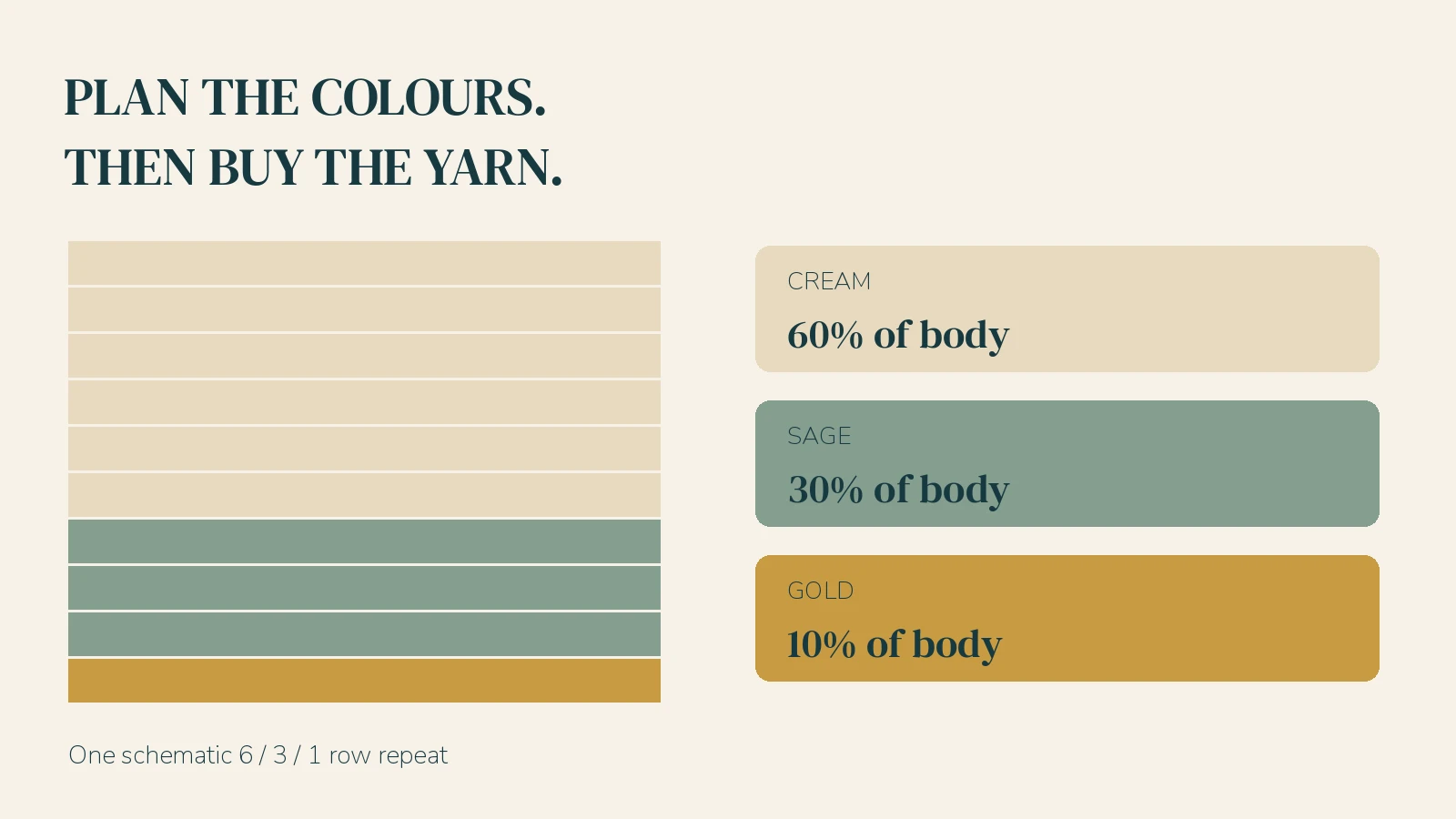
Estimate the blanket body from your own swatch, divide that amount between the colours, then add the border and finishing yarn before rounding each colour up to whole balls. Three colours rarely mean three equal purchases. A narrow accent stripe may need one ball while the main colour needs three.
This guide works through one example and gives you a table to reuse. It is a planning calculation, not a blanket pattern. The example is hypothetical. Replace its inputs with your measurements and the labels on the yarn you intend to buy.
Start with a body size and a stripe plan
Choose a pattern and the size of the blanket body before estimating yarn. In this example the body is 30 × 30 inches (76.2 × 76.2 cm), before the border. A border makes the final blanket larger. If you are choosing a size, use our baby blanket size guide to compare dimensions rather than treating the example as a size requirement.
For the stripes, imagine a repeat of six rows of cream, three of sage and one of gold. Ten complete repeats give 100 rows: 60 cream, 30 sage and 10 gold. These are colour assignments, not stitch instructions. Your pattern determines how many stitches and rows produce your chosen dimensions.
With equal-length rows in the same stitch and comparable yarn, that is a starting allocation of 60%, 30% and 10% of the body yarn. If you stop part-way through a repeat, count the actual rows of each colour instead. For palette ideas, see baby blanket colour combinations.
Measure yarn consumption as well as gauge
Make a representative swatch with your intended yarn, hook and stitch. Follow the yarn’s care instructions when preparing it, let it dry fully, and record its finished width, height and yarn consumption. Keep the measuring method consistent: the yarn you weigh must belong to the area you measure. Loose tails, labels and clips should not be included in the fabric weight.
The Craft Yarn Council asks designers for a swatch in the project stitch. A plain swatch cannot tell you how much yarn a different textured stitch will consume. If your scale cannot reliably resolve the small weight difference, use a larger swatch or measure the yarn length directly.
For a flat rectangle in a consistent stitch:
Body yarn ≈ swatch yarn × (body width × body height) ÷ (swatch width × swatch height).
Use one unit for all four dimensions. Inches work with inches; centimetres work with centimetres. The result stays in the unit you used for yarn: grams if you weighed it, metres or yards if you measured its length.
A hypothetical swatch calculation
Suppose a dry 6 × 6 inch (15.24 × 15.24 cm) swatch uses 12 g of yarn. Its area is 36 square inches. The planned body is 900 square inches, so it contains 25 swatch areas.
12 g × 25 = 300 g estimated body yarn.
This estimates consumption; it does not determine the starting chain or guarantee the finished size. Check stitch and row gauge against your pattern separately. Foundation and edge effects, tension changes and finishing can make a small swatch scale imperfectly.
Divide the body yarn, then add what sits outside it
For the example’s complete six-three-one repeats, the 300 g body estimate divides into 180 g cream, 90 g sage and 30 g gold. Do not take these percentages from the final blanket’s visual area if the border uses another stitch or thickness.
A border needs its own estimate, ideally from a sample in the actual border stitch, including its corners. Count cut-and-rejoined colour changes and allow for the tails your joining method requires. Do not assume that carrying yarn and cutting it use identical amounts.
For demonstration only, the next table assigns 30 g to a cream border and 6 g, 4 g and 2 g to finishing in the three colours. These are placeholders, not recommended allowances for your pattern. We then add a chosen 15% planning margin. That margin illustrates the calculation; it is not a measured accuracy range or a guarantee against running short.
| Colour | Body | Border allowance | Finishing allowance | Subtotal | With chosen 15% margin |
|---|---|---|---|---|---|
| Cream | 180 g | 30 g | 6 g | 216 g | 248.4 g |
| Sage | 90 g | 0 g | 4 g | 94 g | 108.1 g |
| Gold | 30 g | 0 g | 2 g | 32 g | 36.8 g |
| Total | 300 g | 30 g | 12 g | 342 g | 393.3 g |
Round each colour to whole balls
Suppose every colour is sold in a hypothetical 100 g ball with 220 m on its label. This is an invented example label, not a claim about a product. Divide each colour’s requirement by its ball weight, then round up:
| Colour | Planned need | Calculation | Whole balls to buy | Purchased weight |
|---|---|---|---|---|
| Cream | 248.4 g | 248.4 ÷ 100 = 2.484 | 3 | 300 g |
| Sage | 108.1 g | 108.1 ÷ 100 = 1.081 | 2 | 200 g |
| Gold | 36.8 g | 36.8 ÷ 100 = 0.368 | 1 | 100 g |
| Total | 393.3 g | Round colours separately | 6 | 600 g |
Rounding the combined 393.3 g to four balls would miss the colour allocation. A spare gold ball cannot replace missing sage without changing the design.
If you work in length, the example label gives 2.2 m per gram. The three requirements become about 546.5 m, 237.8 m and 81.0 m, again rounding to three, two and one 220 m balls. Use your actual label’s length. Lion Brand explains why yardage per ball matters when comparing yarns: equal ball weights need not contain equal lengths.
Your per-colour shopping worksheet
Copy this table once for every colour. Keep the unrounded estimates until the final purchase step.
| Field | Your entry |
|---|---|
| Pattern and intended body dimensions | ___ |
| Swatch dimensions and dry fabric weight or measured yarn length | ___ |
| Estimated body yarn for the whole blanket | ___ |
| Colour name, product and shade code | ___ |
| Actual rows in this colour / total body rows | ___ / ___ |
| Body estimate for this colour | ___ |
| Separate border estimate in this colour | ___ |
| Finishing allowance in this colour | ___ |
| Chosen extra margin and reason | ___ |
| Planned requirement after allowances | ___ |
| Label weight and length per ball | ___ g / ___ m or yd |
| Whole balls, rounded up for this colour | ___ |
| Dye lot checked, where applicable | ___ |
For a length-based plan, divide the required metres by metres per ball, or yards by yards per ball. Do not divide metres by a yard label. If you already own yarn, subtract the usable amount of the matching colour and product before rounding your additional purchase.
When row percentages are the wrong shortcut
The row-share method needs comparable rows. Recalculate or measure each colour separately when rows differ in width, one colour forms bobbles or another texture, yarn is carried through stitches, or you substitute a different yarn. Even shades in one range can have different label lengths; check each label and swatch any change that affects the fabric.
For a shaped blanket, motifs or mixed stitches, start with the pattern’s colour-specific quantities when supplied. Otherwise estimate each distinct section from a representative sample. Do not force a rectangular area calculation onto a construction it does not describe.
If you keep your swatches rather than reuse their yarn, budget for those separately too. Do not assume they are included in the body or border calculation.
Buy with the finished gift in mind too. Our baby blanket yarn guide covers material choices; retain each colour’s written care instructions and check that they are compatible before combining them. Dye-lot labels, where used, should match within a colour. Different colours do not need to share one dye-lot number.
What most yarn plans miss
A colour proportion is not a shopping list. It describes the body only until you add the border, joining method and whole-ball sizes. A small accent can still require an entire ball, while a border can turn the apparently generous main-colour purchase into a shortage.
Our broader blanket yardage guide discusses whole-project estimates. For this per-colour method, use your measured swatch rather than importing generic stitch multipliers. Gauge counts alone do not measure yarn consumption.
Common questions
Can I divide a pattern’s total yardage equally between three colours? Only as an estimate when each colour has an equal share of comparable work. Check whether the total includes a border and whether the designer supplies colour-specific amounts first.
Will a 15% margin always be enough? No. It is a chosen planning input in this example. Swatch size, yarn variation, stitch changes and an uncertain border estimate can all affect the result. Use better measurements rather than treating a margin as certainty.
Can I use the leftover yarn for a matching hat? Possibly, but weigh or measure what remains and compare it with that hat pattern’s requirements. The purchase table predicts availability, not the exact amount left after making a real blanket.