Crochet Baby Gifts by How Long They Take to Make
A washcloth is an evening, a hat or a pair of booties is two to three hours, a lovey blanket is three to five, and a crib blanket is thirty to fifty-five. Those four numbers cover most of the decisions people actually face.
The surprising one is the booties. A pair of booties is a fraction of the size of a lovey blanket and takes nearly as long, because size is not what drives the hours — shaping, seaming and having to make a second one are.
The table
Worsted-weight yarn, a moderate pace, no complicated colourwork. Ranges are wide on purpose.
| Gift | Rough size | Hours | What it needs |
|---|---|---|---|
| Washcloth | 8 × 8 in | 1–2 | One stitch, worked flat |
| Headband | Newborn | 1–2 | One stitch, one seam |
| Simple bib | 8 × 9 in | 1.5–3 | Flat, plus a neck opening |
| Booties, a pair | Newborn | 2–3 | Worked in the round, shaping, two of them |
| Hat | Newborn | 2–3 | Worked in the round, decreasing |
| Small amigurumi | 5–6 in | 3–6 | Tight gauge, shaping, assembly |
| Lovey blanket | 14 × 14 in | 3–5 | Flat, plus a small toy head |
| Hat and booties set | Newborn | 4–6 | The two above, same yarn |
| Photo-prop cocoon | Newborn | 6–10 | Worked in the round, long. A prop, never sleepwear |
| Preemie blanket | 18 × 24 in | 7–12 | Flat, one stitch |
| Larger amigurumi | 10–12 in | 8–15 | Multiple pieces, a lot of assembly |
| Baby cardigan | 6–12 months | 12–20 | Shaping, seaming, buttonholes |
| Receiving blanket | 30 × 30 in | 15–25 | Flat, plus a border |
| Stroller blanket | 30 × 35 in | 18–30 | Flat, plus a border |
| Crib blanket | 36 × 52 in | 32–55 | Flat, plus a border, sustained |
| Full layette | Blanket, hat, booties, cardigan | 40–70 | All of the above |
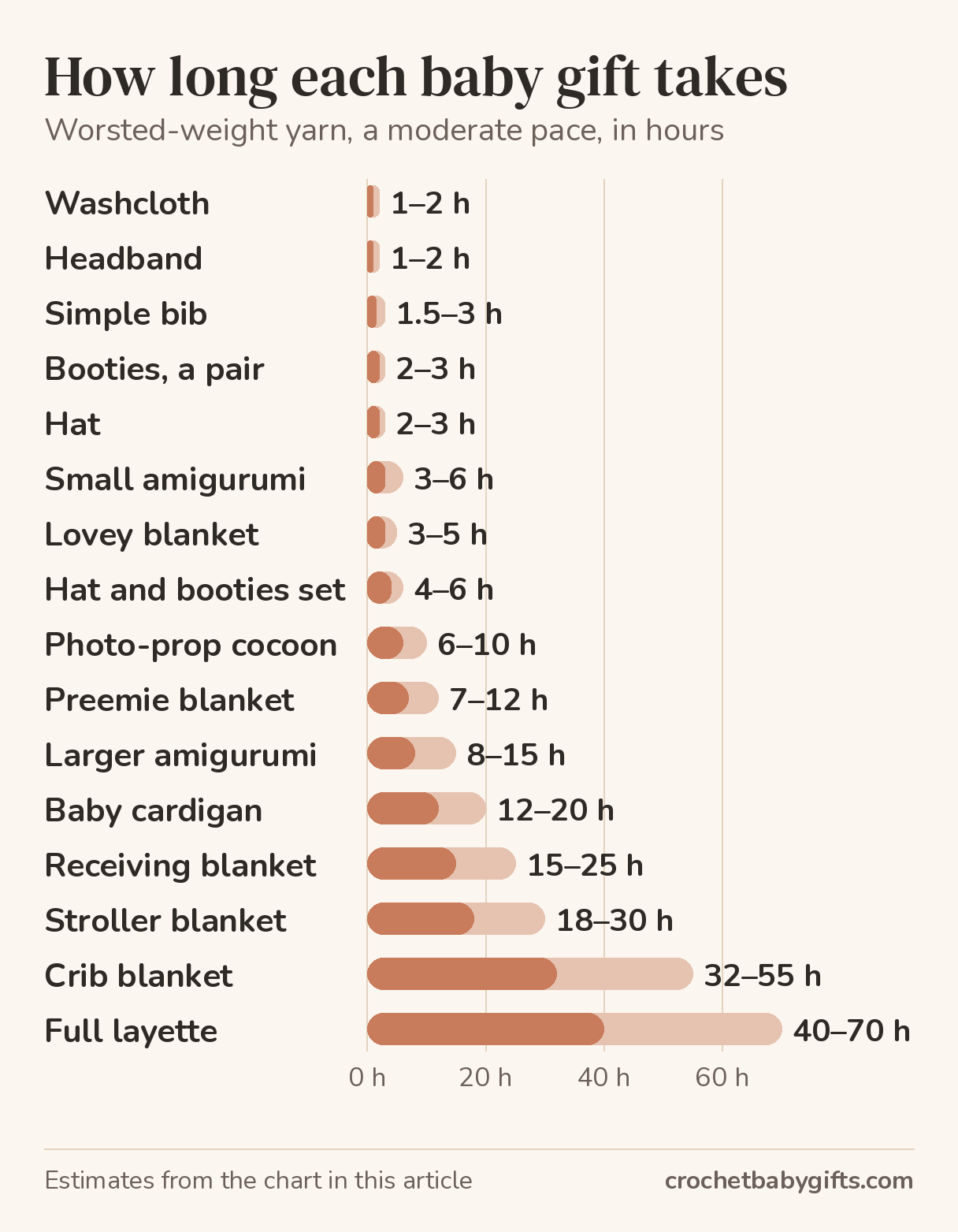
How these numbers were produced
Stated openly, because a table of hours with no method behind it is worth very little.
The blanket rows are taken directly from how long a baby blanket takes, which works from surface area at a measured rate in worsted yarn and double crochet. The non-blanket rows apply the same rate to a much smaller surface, then add two adjustments:
- A multiplier for short stitches. Hats, booties and amigurumi are worked mostly in the shortest basic stitch, which is roughly 1.8× the time of double crochet for the same area.
- A fixed overhead for finishing. Seaming, weaving in ends, sewing on a face, and setting in a button band do not scale with size. On a small project this overhead is a large share of the total; on a blanket it disappears into the noise.
That second adjustment is why the small items cluster around two to three hours instead of the twenty minutes their surface area suggests. Our pencil case pattern and phone bag pattern use the same time model for their own estimate of 3 to 5 hours of crochet.
These are estimates and they are labelled as estimates. Treat the range as roughly ±50%, because individual speed varies more than any other input here.
Get your own number in ten minutes
More accurate than this table, and it is the same method as the blanket article.
- Crochet for exactly 15 minutes in the yarn, hook and stitch you plan to use.
- Measure what you made — width × height in square inches.
- Divide by 0.25 to get your square inches per hour.
- Divide the project’s surface area by that number.
- Add 15% for finishing, and more if there is seaming.
Ten minutes of measuring beats any published estimate, including this one, because it measures your hands.
Our baby blanket pattern gives the total stitch count instead, so you can count the stitches you make in ten minutes and divide.
Choosing by deadline
The table people actually need.
| Time until you must hand it over | Make this |
|---|---|
| This evening | Washcloth, headband |
| A weekend | Hat and booties set, small amigurumi, lovey |
| Two weeks | Preemie blanket, cocoon, larger amigurumi |
| A month | Receiving or stroller blanket |
| Two months or more | Crib blanket, cardigan, layette |
One rule that overrides the whole table: a finished small gift beats an unfinished large one, every time. If a shower is three weeks away and the crib blanket is at forty per cent, make the hat and booties, and give the blanket later as its own present. Nobody has ever been disappointed by a second gift arriving in month three.
What actually makes something slow
Four things, in order of how much time they add.
Seaming. Anything made in pieces costs assembly time that is invisible in the pattern and lands at the end. A cardigan is not slow because of its size; it is slow because of the shoulders, the sleeves, the band and the buttonholes.
Making two of something. Booties, mittens and sleeves come in pairs. The second one takes as long as the first and is considerably less interesting, which is its own kind of cost.
Colour changes. Every one is a tail to weave in. A ten-colour striped blanket carries an hour or more of weaving that no hour-per-square-inch estimate captures.
Short stitches. The shortest basic stitch takes nearly twice as long as double crochet to cover the same area. This is the largest single lever you control before starting, along with yarn weight.
And one thing that does not make something slow, despite looking as though it should: size, on flat items. Blankets are the fastest crochet there is per square inch, because there is no shaping, no assembly and nothing to fit.
What most guides get wrong
They rank gifts by size and call it a time ranking. Booties are tiny and take nearly as long as a lovey. The correlation between size and hours breaks down completely below about a square foot, which is exactly where “quick gift” lists live.
They quote the writer’s own speed as if it were general. Experienced crocheters are two to three times faster than beginners at the same stitch, and the people writing these lists are experienced crocheters. Double everything for a first project.
They omit finishing. Assembly, weaving and blocking are real hours, they are the least enjoyable hours, and they arrive when the deadline is closest.
They treat a matching set as free. A hat and booties set is not a project; it is three projects, one of which is a duplicate.
Frequently asked questions
What is the quickest crochet baby gift? A cotton washcloth — one stitch, worked flat, no shaping, no seam, an evening. It is also genuinely useful, which is more than can be said for some faster options.
Can I crochet a baby gift in a weekend? Comfortably: a hat and booties set, a small amigurumi, or a lovey. At a stretch with bulky yarn: a preemie blanket. Not: a crib blanket.
How long does a baby hat take? Two to three hours in worsted weight for someone comfortable with working in the round; four to six for a first attempt. Bulky yarn roughly halves it.
What should I make if the baby is already born? Something in a 6–12 month size rather than newborn. By the time it is finished the newborn size will be tight, and the larger size gets months of use.
Does bulky yarn really save that much time? Yes — roughly 40% off, and super bulky more. It is the single biggest lever. Avoid super bulky for anything worn, though: the gaps between stitches are large enough for fingers and toes.