Crochet Baby Boots With a Sewn Bow: Free High-Top Bootie Pattern, 0 to 12 Months
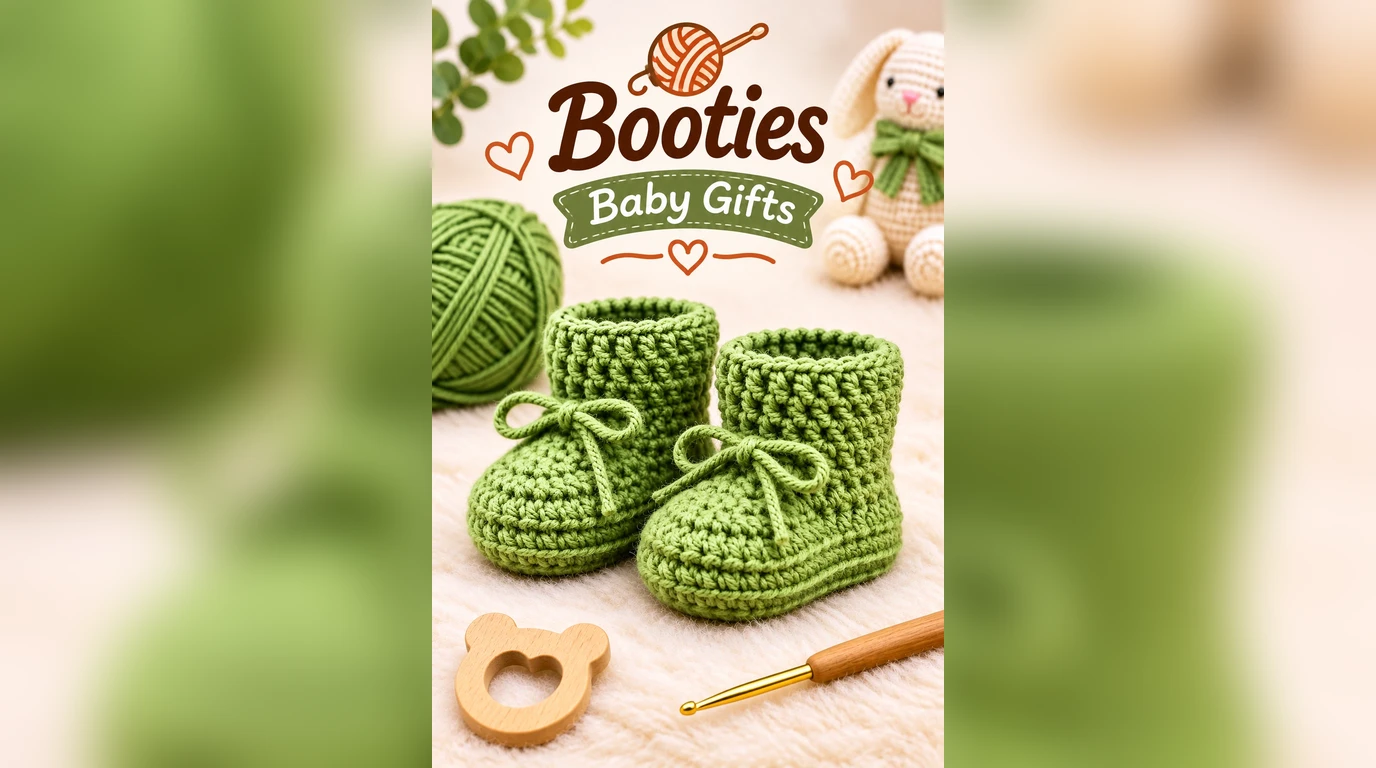
Crochet an oval sole, turn up a ridged sole edge, shape the toe over three rounds, then work a tall cuff of post stitch ribbing to mid-calf and finish it with a rolled edge. A short bow is tied once and sewn down at the front of the ankle. The ribbed cuff hugs the ankle, which is what keeps the bootie on. In DK yarn on a 3.5 mm hook the 0–3 month sole comes out about 9 cm long, and the bootie stands about 6.5 cm tall at the back.
The bows in the picture look like ties that undo. On this pattern they cannot. A loose cord on a baby can catch round a neck, a finger or a toe, so on this pattern the bow is a short crocheted cord, tied once, sewn through the bootie at the knot, with every loop and end sewn flat. The cuff, not the bow, keeps the bootie on.
Download the free printable PDF: the whole pattern, the size table and the diagram, ready to print. No sign-up.
This is our own design. A script checks every round against the one before it, the sole against our baby bootie size chart, and the cuff against measured baby ankles and legs. The sizes are worked out from a gauge, so the first thing to check is your own sole against the size table.
Find what you need: pick your size · will it go on and stay on? · materials · the video · the pattern · made for a baby.
Pick your size
| Size | Sole length | Foundation chain | Ankle round | Heel it must pass | Height at the back | Yarn for the pair |
|---|---|---|---|---|---|---|
| 0–3 months | about 9 cm (3.5 in) | 10 ch | 24 sts, about 12 cm round, for ankles of 10.2 to 12.9 cm | 16.8 cm round, a stretch of 40% | about 6.5 cm, 3 ribbed rounds | about 55 m |
| 3–6 months | about 10 cm (4 in) | 12 ch | 26 sts, about 13 cm round, for ankles of 11.6 to 13 cm | 16.9 cm round, a stretch of 30% | about 7.5 cm, 4 ribbed rounds | about 65 m |
| 6–12 months | about 11.5 cm (4.5 in) | 15 ch | 28 sts, about 14 cm round, for ankles of 12.9 to 14.5 cm | 18.9 cm round, a stretch of 35% | about 8.5 cm, 5 ribbed rounds | about 75 m |
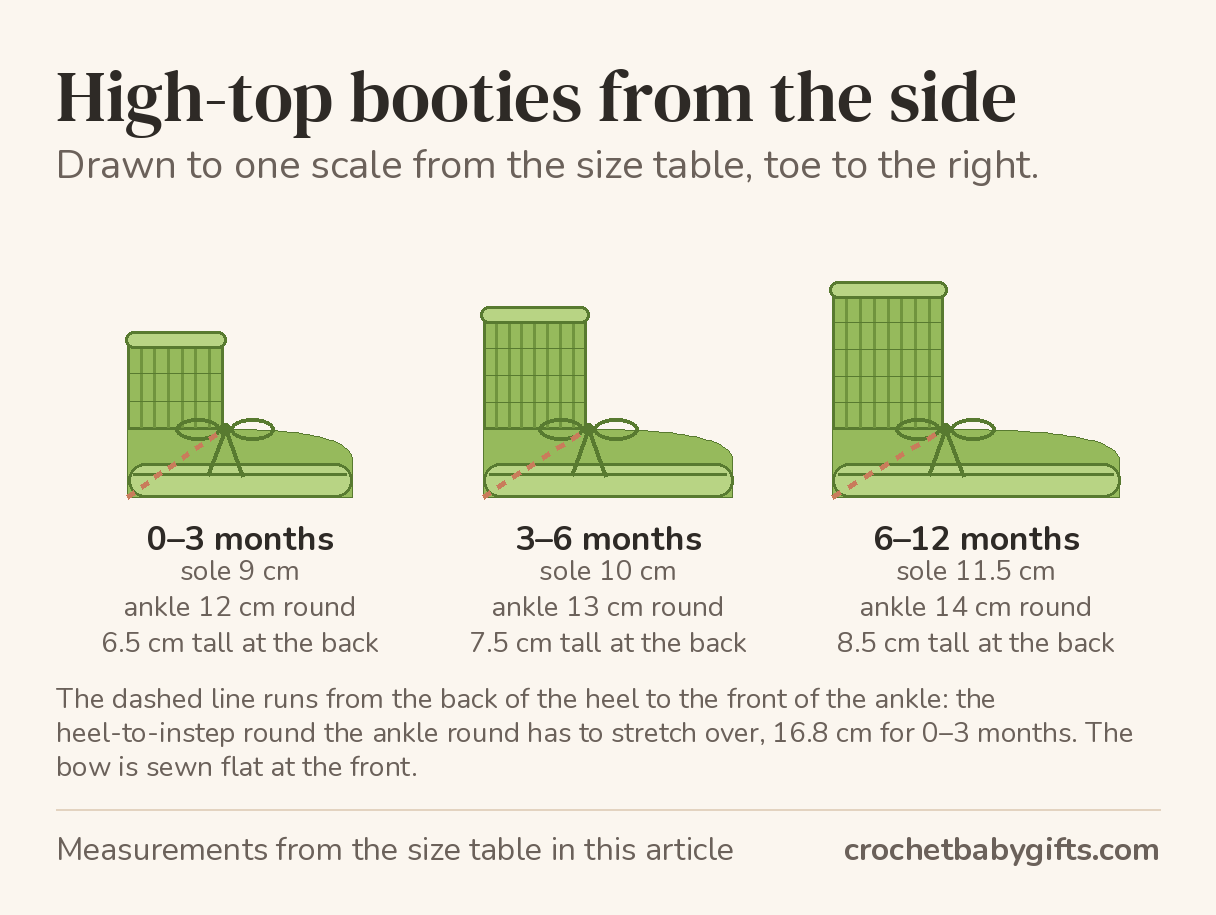
The sole lengths are the ones on our bootie size chart, which already allow a little room past the toes. The sole is one round wider than the one on our ribbed baby booties, so at every size it is at least as wide as an average baby’s foot. The cuff stands up instead of folding over.
Which size, quickly: for a gift with no measurements, make 3–6 months. A bootie that is a little long is worn for longer; one that is short is not worn at all.
Will it go on, and will it stay on?
A boot with no opening down the front has one round that does both jobs: the ankle round, where the top of the foot meets the cuff. To go on, it has to stretch over the widest part of the foot that passes through it, the round from the back of the heel over the front of the ankle. To stay on, it has to be small enough that the heel cannot slip back out without stretching it.
There is no published measurement of that heel round for babies that we could find, so we estimate it. Sock knitters call it the heel diagonal. Marly Bird’s sock worksheet, citing a study by Kate Atherley in her book Custom Socks, makes the heel of a sock 30 to 40% bigger round than the rest of it. We take the lower 30%, and apply it to a large baby ankle: the ankle round that only one baby in twenty is bigger than, from a US survey of infants, 12.9, 13 and 14.5 cm for the three sizes. That gives a heel-to-instep round of 16.8, 16.9 and 18.9 cm. The ratio comes from adult socks, and a sock’s heel is made a little smaller than the foot, so a real heel may be bigger: the check in section 2 of the pattern is what settles it.
Goes on. The ankle round is about 12, 13 and 14 cm, so to pass that heel it has to stretch by 40, 30 and 35%. For an average baby it is 10, 16 and 20%. We could not find a published figure for how far crochet ribbing stretches, so this is a planning limit, not a measurement. We set a limit of 40%, and the pattern has you test the round before you work the cuff.
Stays on. The ankle round is never bigger than that large ankle, so it touches even a big ankle all the way round. It is also smaller than an average baby’s heel round, 13.3, 15.1 and 16.8 cm, so the heel has to stretch the ribbing to come back out. Any cuff that fits a large ankle snugly has to stretch by at least 30% to go over that baby’s heel, which is why this one is ribbing and not plain stitches.
If you can measure the baby, measure round the back of the heel and over the top of the foot where it bends at the ankle. The ankle round has to stretch to that.
How tall. The top edge sits between 40 and 50% of the way up an average baby’s lower leg, which the same survey measured at 14.9, 16.5 and 19.8 cm from knee to sole. That is mid-calf, well clear of the knee.
What you need
Every tool our patterns use is on the Crochet essentials page.
- DK (#3) baby yarn in green, the amount in the size table, soft and machine washable. One 50 g ball of most DK yarns (125 m or more) makes a pair of any size here.
- A 3.5 mm crochet hook, and a 4 mm hook for the top edge. The hook size chart gives the US letters near them.
- One stitch marker, a blunt tapestry needle and scissors.
Gauge and abbreviations
Gauge: about 20 single crochet and 22 rounds to 10 cm (4 in) on a 3.5 mm hook, and a round of post double crochet about 1.1 cm tall. We have not measured this on the booties yet. It is a planning figure from published DK gauges, the single crochet one the same as our ribbed booties use, and every size on this page is worked out from it.
The quick check is the sole: after round 5 it should be the length in the size table. If it is more than 0.5 cm off, change your hook by half a size and start again.
US crochet terms throughout. The UK name is in brackets.
- ch: chain. sl st: slip stitch. st(s): stitch(es).
- sc: single crochet (UK: double crochet). dc: double crochet (UK: treble).
- inc: increase, 2 sc in the same stitch. dec: decrease, sc 2 stitches together.
- fpdc: front post double crochet (UK: front post treble). Yarn over, push the hook in from the front, round the back of the next stitch’s post and out to the front, and finish the dc. The stitch sits forward.
- bpdc: back post double crochet (UK: back post treble). The same, with the hook going round the post from the back. The stitch sits back.
- reverse sc (UK: reverse double crochet), also called crab stitch: single crochet worked from left to right instead of right to left (the other way if you crochet left-handed). It makes a firm, rolled edge.
- Back loops only: work into just the loop of each stitch that is furthest from you.
- Back bump: the ridge of yarn on the back of a chain.
- 10 (12, 15): the first number is for 0–3 months, the ones in brackets for 3–6 and 6–12 months.
The video
Crochet Art of Loving’s video makes a green bootie like the one in the picture, in a different way from ours. She chains a ring twice as long as the baby’s foot and works it up in rounds of half double crochet into the back loops. She decreases over the top of the foot, works a few plain rounds for the cuff, then folds the piece flat inside out and sews the bottom closed, drawing the heel and toe round. She finishes with a bow of the same yarn at the front. Ours starts from an oval sole, so there is no seam under the foot, the cuff is ribbed so it holds the ankle, and the bow is sewn down.
- Chaining twice the length of the baby’s foot, from 0:44.
- Joining the chain into a ring, from 1:24.
- Half double crochet into the back loops, which leaves a ridge on the outside, from 2:39.
- The decreases over the top of the foot, from 4:21.
- Folding the bootie inside out and sewing the sole, from 9:57.
- The finished bootie with its bow at the front, from 11:50. On ours the bow is sewn down.
Video: Crochet Art of Loving, “Sapatinho de Crochê Perfeito para o Inverno”, 2025, in Portuguese, about 13 minutes. A similar bootie; the pattern on this page is our own.
The pattern
Make two. Every round is joined with a sl st in the first stitch and starts with ch 1, which does not count as a stitch (ch 2 before a ribbing round). Do not turn. Put a marker in the first stitch of each round: it sits at the back of the heel, a little to one side.
1. Sole
- Foundation: ch 10 (12, 15).
- Rnd 1: sc in 2nd ch from hook, sc 7 (9, 12), 3 sc in last ch; working along the other side of the chain, sc 7 (9, 12), 2 sc in last ch. [20 (24, 30) sts]
- Rnd 2: inc, sc 7 (9, 12), [inc] 3 times, sc 7 (9, 12), [inc] 2 times. [26 (30, 36) sts]
- Rnd 3: sc 1, inc, sc 7 (9, 12), [sc 1, inc] 3 times, sc 7 (9, 12), [sc 1, inc] 2 times. [32 (36, 42) sts]
- Rnd 4: sc 2, inc, sc 7 (9, 12), [sc 2, inc] 3 times, sc 7 (9, 12), [sc 2, inc] 2 times. [38 (42, 48) sts]
- Rnd 5: sc 3, inc, sc 7 (9, 12), [sc 3, inc] 3 times, sc 7 (9, 12), [sc 3, inc] 2 times. [44 (48, 54) sts]
The round starts at the heel end of the oval, so the toe is the far end, where the 3 sc went into the last chain. Check the sole now: it should be about 9 (10, 11.5) cm long.
2. Sole edge and toe
- Rnd 6: in back loops only, sc in each st. [44 (48, 54) sts]
- Rnds 7–8: sc in each st. [44 (48, 54) sts]
- Rnd 9: sc 10 (10, 11), [dec] 10 (12, 14) times, sc 14 (14, 15). [34 (36, 40) sts]
- Rnd 10: sc 8 (9, 9), [dec] 6 (6, 8) times, sc 14 (15, 15). [28 (30, 32) sts]
- Rnd 11: sc 8 (9, 10), [dec] 4 (4, 4) times, sc 12 (13, 14). [24 (26, 28) sts]
Round 6’s free front loops make the ridge round the sole in the picture, and rounds 7 and 8 are the sole edge above it. The decreases all sit over the toe, so the heel stays round and the top of the foot draws in to the ankle. Round 11 is the ankle round.
Test the ankle round now. Flatten the bootie at round 11 and pull the two folds apart gently along a ruler. Without the stitches gaping, it should open to at least 8.5 (8.5, 9.5) cm across, which is half the heel round in the size table. If it will not, unpick round 11 and work it again on the 4 mm hook, and work the cuff on the 4 mm hook too.
3. Cuff
- Rnds 12–14 (12–15, 12–16): [fpdc around next st, bpdc around next st] around. [24 (26, 28) sts]
Change to the 4 mm hook for the last round, so the top edge is not the tightest round of the cuff.
- Rnd 15 (16, 17): reverse sc in each st. [24 (26, 28) sts]
From round 13 on, the fpdc goes round each stitch that sits forward and the bpdc round each stitch that sits back, so the ribs stack up in straight columns. The cuff is about 4 (5, 6) cm tall, and the bootie about 6.5 (7.5, 8.5) cm tall at the back. Fasten off and weave in the ends.
4. The sewn bow
Make 2, one for each bootie.
- Cord: ch 29 (29, 31), then sl st in the back bump of the 2nd ch from hook and of each ch across. [28 (28, 30) sl st]
Fasten off and weave both ends back into the cord, so the cord is about 14 (14, 15) cm long with nothing hanging from it.
- Tie the cord once into a small bow, with two loops about 2 cm long and two ends about 2 cm long. Pull the knot tight.
- Lay the knot on the centre front of round 11, where the top of the foot meets the cuff. To find it, count 10 (11, 12) stitches, starting with the marked stitch: the last one you counted is the centre front.
- Thread the needle with 40 cm (16 in) of the same yarn. Sew through the knot and the bootie at least 6 times, then knot the yarn on the inside.
- Sew each loop and each end flat to the bootie with small stitches about 0.5 cm apart, so no loop stands open and no end lifts. Weave the sewing yarn in for at least 5 cm (2 in).
When it is done there is nothing to untie and nothing to pull long. If you would rather leave the bow off, the booties stay on just the same: the cuff does that job.
5. Finishing
Weave every tail into the inside of the stitches, back and forth through several stitches, then trim it close. Turn each bootie inside out and check that there are no loose loops or strands inside, then turn it back.
Try it on if you can. The cuff should hold the ankle without leaving a mark. If the top leaves a red line on the leg, work the last two ribbing rounds and the edge again on the 4 mm hook.
Made for a baby
- No working ties or long cords. Here the bow is tied once, sewn through the bootie at the knot, and every loop and end is sewn flat, so it cannot be untied or pulled long. The cord is short too: even if every stitch holding it came out, neither half could hang more than 7.5 cm from the knot.
- No buttons, beads or small parts. There is nothing on these to come off: the bow is crocheted and sewn on.
- They are not walking shoes. A crochet sole has no grip, so these are slippery on hard floors. Keep them for a baby who is not yet standing or walking, or for carpet.
- Check inside for loose threads. A loose thread or hair can wind round a baby’s toe and cut off the blood flow, which doctors call a hair tourniquet.
- A cuff that does not mark. A ribbed cuff holds by stretch, with no elastic, and it should never leave a groove.
The sources for each point are on our handmade baby gift safety checklist.
Yarn and time
A 0–3 month pair takes about 55 m. The amounts come from counting every stitch and allowing a published length of yarn per stitch for DK, so they are upper estimates.
It is about 470 stitches a bootie, most of them single crochet.
If something goes wrong
The bootie will not go on. The ankle round is too tight. Test it as in section 2, and if it will not open far enough, work round 11 and the cuff on the 4 mm hook.
The bootie falls off. Check the sole length first: a sole that is too long lets the heel ride up out of the cuff. If the length is right, work the ribbing a little tighter, but test the ankle round again afterwards.
The ribs lean instead of stacking. Check that you are going round the post of the stitch below, not into its top, and that each fpdc sits on a stitch that came forward.
The bow lifts at one end. Sew it down again before the next wear.
Frequently asked questions
Can I make the bow a real tie? We do not recommend it. A tie that undoes is a loose cord on a baby, and the cuff already keeps the bootie on.
Will they stay on? The ribbed cuff hugs the ankle and the bootie is too small round the ankle for an average heel to slip out without stretching it. A sole that is too long is the usual reason a bootie comes off, so check the length against the table.
Can I leave the bow off? Yes. Nothing else changes.
Is this a good first project? It suits a confident beginner. Everything is single crochet except the post stitch ribbing and one round of reverse sc; the bow is a chain and a row of slip stitches.
See also
- Easy crochet baby booties, a half double crochet bootie in four sizes
- Ribbed crochet baby booties, with a fold-over ribbed cuff
- Crochet Christmas baby booties, in red and cream with a bow
- Crochet baby socks, toe-up with a ribbed cuff
- Baby bootie size chart for sole lengths by age